You will typically pay $40–$150 for a basic chicken egg incubator in 2025. Mid-range models with better automation and accuracy usually cost $150–$400. Commercial cabinet incubators for larger batches often start around $500 and can exceed $1,500 depending on capacity and features. A good incubator should offer reliable temperature control, adequate humidity management, and—ideally—automatic turning. The table below summarizes key features to check:
|
Feature |
Description |
|---|---|
|
Forced Air Incubators |
Fan circulates air so all eggs see more uniform temperature. |
|
Auto Temperature Control |
Digital set-point with tight hysteresis (see temperature guide). |
|
Humidity Control |
Easy-fill water channels or pumps; clear hygrometer readout. |
|
Automatic Turning |
Prevents embryos from sticking; reduces manual workload. |
|
Easy Cleaning |
Removable trays and smooth surfaces reduce contamination risk. |
|
Visibility |
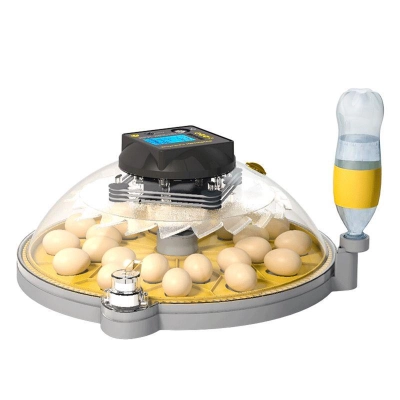
Window or clear lid helps monitor development without opening. |
Incubators cost more as capacity and automation increase. Extra features like multi-tray automatic turning, alarms, or app monitoring add convenience and consistency—useful if you hatch frequently. Always review the incubator instructions before use.
Key Takeaways
-
Price tiers are consistent: entry $40–$150; mid-range $150–$400; commercial $500–$1,500+.
-
Look for automatic turning, stable temperature, and clear humidity control—they most affect hatch outcomes.
-
Running cost is modest but not negligible—electricity typically ranges from low tens of dollars per year for small units.
Chicken Egg Incubator Cost in 2025
Prices vary by capacity, build quality, and controls. Here is how tiers typically break down for 2025:
Entry-Level Models
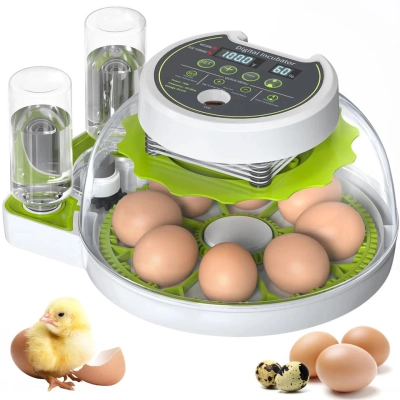
Best for beginners or small flocks (a few eggs per batch). Usually manual or semi-automatic; acceptable stability in a climate-controlled room.
Examples and typical pricing:
|
Brand/Model (examples) |
Price Point |
Typical Features |
|---|---|---|
|
Compact 7–12-egg units |
$40–$120 |
Basic thermostat, viewing window, optional manual turning. |
|
Foam box 30–40-egg |
$90–$150 |
Forced air, digital readout, optional turner add-on. |
Tip: Entry units are ideal for learning and occasional hatches; place them away from drafts and large temperature swings.
Mid-Range Models
More automation and tighter control—good for frequent hobby hatches or small farms.
|
Feature |
Entry-Level Models |
Mid-Range Models |
|---|---|---|
|
Price |
$40–$150 |
$150–$400 |
|
Automation |
Manual or partial |
Automatic turning; alarms |
|
Temp/Humidity |
Basic thermostat; manual humidity |
PID-style control; easier humidity management |
|
Use case |
Occasional small batches |
Regular hatching; higher consistency |
Commercial and Large-Scale Models
Cabinet incubators offer higher capacity (hundreds of eggs), better air distribution, and robust components. These start around $500 and commonly exceed $1,500 when adding hatcher sections, multiple trays, and advanced controls. They shine when you need scale and repeatability.
If you’re scaling up or selling chicks, a cabinet incubator with separate hatcher space improves throughput and workflow.
Cost of Running an Incubator
Electricity and Maintenance
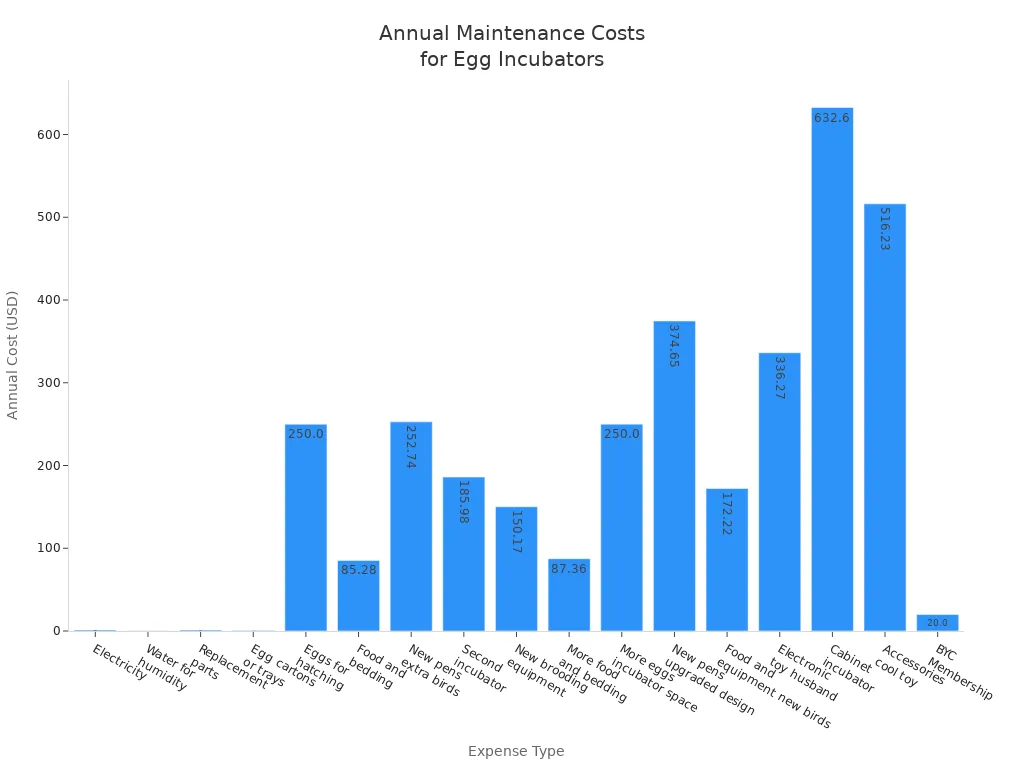
Electricity is the main running cost. Small tabletop incubators commonly draw about 10–20W (duty-cycled), while larger foam or cabinet units may average 40–100W or more depending on room temperature and insulation. Using the U.S. average residential rate (~$0.15/kWh, 2025), realistic annual electricity costs are:
Example calculation (small unit): 12W average × 24h × 365 = 105 kWh/year → ≈ $16/yr at $0.15/kWh.
Example calculation (foam unit): 50W average × 24h × 365 = 438 kWh/year → ≈ $66/yr at $0.15/kWh.
Actuals vary with room temperature, insulation, and duty cycle.Annual Operating Costs (typical ranges)
|
Expense Type |
Typical Annual Cost |
|---|---|
|
Electricity (small tabletop) |
$15–$30 |
|
Electricity (larger foam unit) |
$45–$80 |
|
Water for humidity |
$1–$5 |
|
Replacement parts/consumables |
$5–$20 |
|
Optional trays/egg racks (amortized) |
$10–$30 |
What impacts running cost?
-
Incubator size, insulation, and heater type
-
Ambient room temperature and drafts
-
Your set-points and opening frequency
-
Batch size and hatch frequency
Best Egg Incubators: Features That Matter
Essential Features
Beyond price, prioritize stability and ease of use. These features most affect hatch results and day-to-day workload:
|
Feature |
Description |
|---|---|
|
Automatic Egg Turning |
Even development and fewer handling mistakes. |
|
Built-In Humidity Display |
Quick checks and adjustments during incubation and lockdown. |
|
Precise Temperature Control |
Digital readout; tighter tolerance minimizes temperature swings. |
|
User-Friendly Design |
Clear UI, removable parts, intuitive alarms. |
|
Capacity |
Matches your planned batch size and species. |
|
Cleaning & Maintenance |
Smooth surfaces to sanitize quickly between hatches. |
Tip: Choose models with good support and readily available spare parts. That matters more over years of use than a small price difference today.
Choosing the Right Incubator for Your Budget
Matching Size to Your Needs
-
How many eggs—and which species—will you hatch per batch?
-
How often will you hatch (occasional vs. frequent)?
-
Do you need automation (turning, alarms, app monitoring)?
-
What is your total budget including consumables?
When to Spend More
|
Accuracy Level |
Benefits |
Suitable For |
|---|---|---|
|
±0.1 °C |
Very steady temperature; best for sensitive species. |
Dedicated breeders; critical eggs. |
|
±0.2–0.3 °C |
Great balance of cost and performance. |
Most hobbyists and small farms. |
|
±0.4–0.5 °C |
Adequate for common poultry; more manual oversight. |
Budget setups and learning. |
Recommended Budget Ranges
Use this quick view to match budget to tier in 2025:
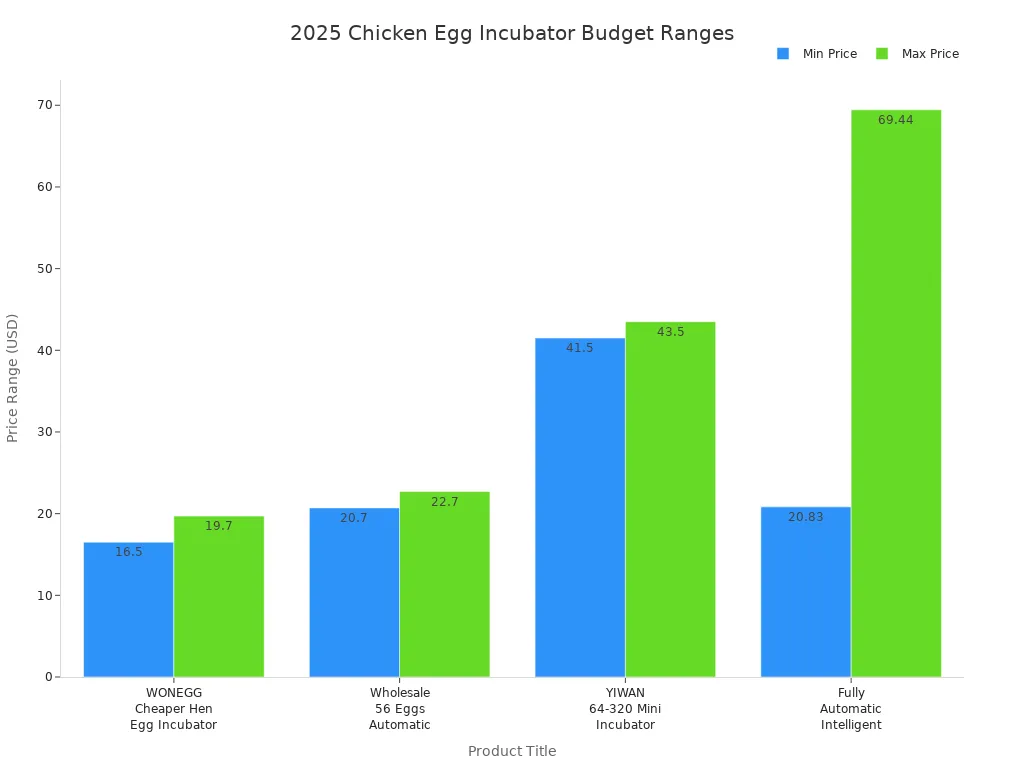
You can buy chicken egg incubators at different prices. Check the table below:
|
Type |
Price ($) |
Capacity (Eggs) |
Features |
|---|---|---|---|
|
Inexpensive |
40–150 |
< 12 |
Manual or basic controls |
|
Mid-range |
150–400 |
12–45 |
Automatic turning; better control |
|
Expensive prosumer |
400–800 |
45–120 |
Advanced controls; alarms |
|
Commercial cabinet |
500–1,500+ |
Hundreds |
Multi-tray; robust build; serviceable |
-
Decide capacity first; that sets your tier.
-
Prioritize automatic turning and stable temperature for better results.
-
Cheaper models trade your time and attention for lower upfront cost.
-
Better models pay back in consistency and reduced failures.
FAQ
How do you improve hatching rates with a chicken egg incubator?
Keep temperature stable, manage humidity (higher at lockdown), minimize opening, and ensure turning until day 18 for chickens (stop for lockdown). Clean and sanitize between batches.
What is the best temperature for hatching eggs in chicken egg incubators?
For forced-air incubators, a common set-point is 99.5 °F (37.5 °C) for chicken eggs. Still-air models often run slightly higher due to stratification.
How often should you turn eggs during hatching?
At least three times daily until lockdown; automatic turning reduces handling variability and improves consistency.
Methods & References
Methods summary: Price tiers reflect market ranges for common retail channels (brand product pages and large retailers). Electricity cost uses nameplate or typical power from product pages/manuals and U.S. average residential price per kWh. Ranges account for duty cycle and ambient temperature effects. Access dates are provided.
-
U.S. Energy Information Administration (EIA). Electric Power Monthly, Table 5.6.A: Average retail price of electricity to ultimate customers. Accessed 2025-11-06. eia.gov
-
Brinsea. Mini II Advance – Product page / User manual (typical 12–20W). Accessed 2025-11-06. brinsea.com
-
GQF Manufacturing. Hova-Bator 1588 Genesis – Product information (≈50W typical). Accessed 2025-11-06. gqfmfg.com
-
ElectricChoice. Average Electricity Rates by State. Accessed 2025-11-06. electricchoice.com
-
University Extension Guides (e.g., UNL; Texas A&M AgriLife). Incubation temperature/humidity best practices. Accessed 2025-11-06. poultry.tamu.edu
-
Representative retailer listings (Amazon/Tractor Supply) for current pricing snapshots of entry, mid-range, and cabinet incubators. Accessed 2025-11-06.
Note: price snapshots vary by retailer and date; quote a range, not a single price.
0 Comments