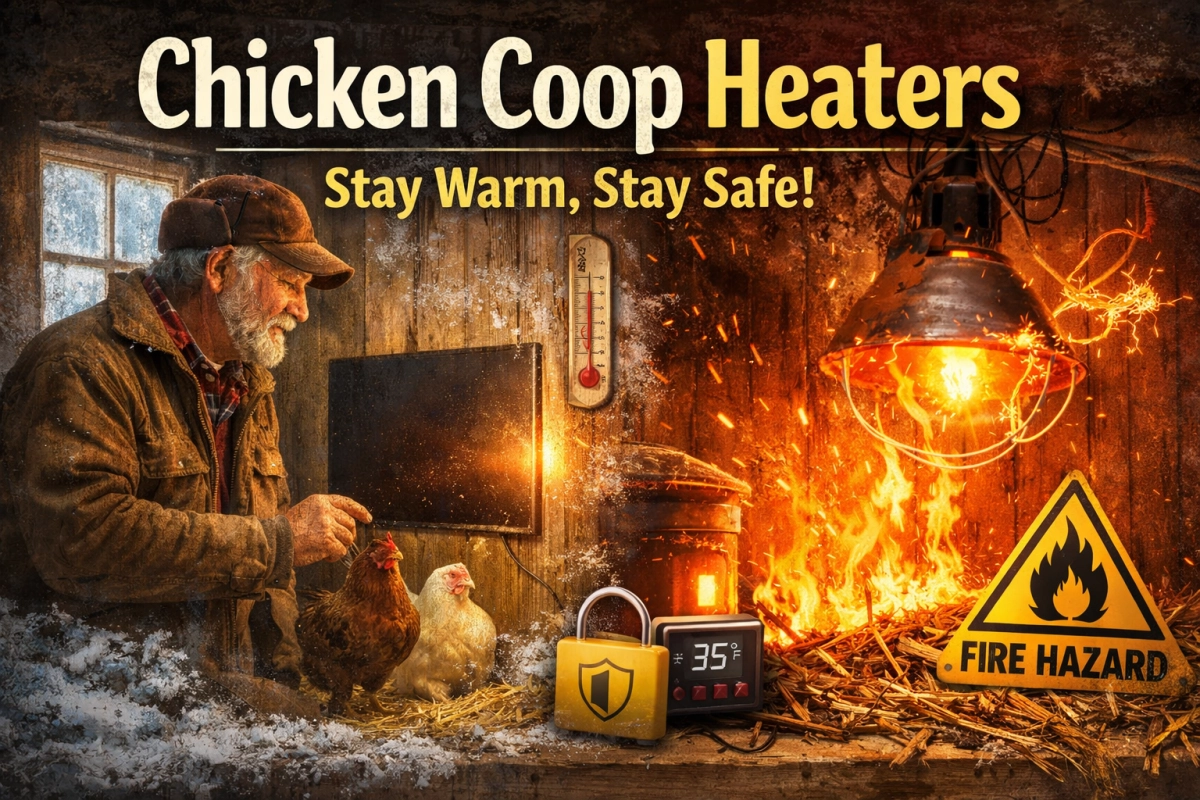
If you’re staring down a long winter and wondering whether chicken coop heaters are the answer, here’s what I’d tell a neighbor leaning on my fence: most healthy adult chickens handle cold a whole lot better than they handle wet air, ammonia, and a sneaky draft across the roost. So the safest approach is usually don’t heat—de-chill. Keep the coop dry, vent it high so damp air can leave, and block wind at bird level so they aren’t sitting in a breeze all night. When temperatures plunge hard or you’ve got special birds that can’t cope, then we talk about gentle, low-surface-temperature radiant heat done the safe way.
Below you’ll find the practical stuff that matters: when heat is actually justified, which heater types are safer, how to size and place them without “overheating the whole barn,” what to watch in your flock, and the non-heating fixes that solve most winter problems. I’ll keep it conservative, because a coop full of dry bedding and dust is no place for risky shortcuts.
Do you really need chicken coop heaters
Most coops don’t. I’ve overwintered plenty of birds with no heater at all. Chickens make their own heat. What gets them in trouble is moisture and drafts—especially that damp air that hangs around and condenses on cold surfaces. Ventilation keeps humidity and ammonia down without blowing air directly on the birds.
Think of it this way: your birds are little furnaces. Your job is to help them keep their heat by keeping bedding dry, sealing cracks where wind hits the roost, and leaving upper vents open so damp air can escape. When might chicken coop heaters be warranted? Here’s the conservative checklist I use:
-
Nighttime coop temperature at roost height sits near the mid-30s Fahrenheit or lower for extended stretches, and you see real cold stress—tight huddling, reluctance to roost, or low energy that doesn’t look like normal winter “quiet time.”
-
You’ve got small birds, sick birds, freshly molted birds, or Mediterranean-type breeds with big combs that frost easier than the stout breeds.
-
Emergencies: a brutal cold snap after rain, storm damage that creates sudden drafts, or other situations where birds can’t stay dry and sheltered.
If those boxes aren’t checked, put your effort into moisture control, wind protection, and roost setup first. Most folks are surprised how often that fixes the problem without ever plugging in a heater.
How heat works in a small coop
Before you compare chicken coop heater types, get the coop behaving right. Warm air rises. Damp air rises. If that damp air can’t get out up high, it turns into condensation on cold surfaces—and that moisture is what sets the stage for frostbite on combs and wattles. So you keep upper vents open year-round, and you seal drafts down low where the birds actually sit.
Deep litter helps too. It soaks up moisture and gives a little steady warmth as it breaks down, and it’s safer than trying to “heat the whole air volume” with a hot appliance. Windbreaks on the prevailing side reduce the bite of the wind, which is often half the battle.
Measure conditions where your birds live—right at roost height. That’s where you decide if you truly need help and where any radiant heat should be aimed. Remember: adult chickens run hot on the inside (around 105–109°F), and healthy birds can tolerate plenty of cold when they’re dry and out of the wind. It’s the wet, drafty, stagnant-air coop that causes trouble.
Safe chicken coop heater types
Not all heat sources behave the same, and not all of them belong in a coop. In general, radiant options that warm birds and nearby surfaces (instead of trying to heat all the air) are the safer, more sensible route when you truly need heat.
Radiant flat panels and hanging radiant options
If I’m going to run heat in a coop, this is where I start. A flat panel chicken coop heater usually runs around 100–200 watts and gives gentle warmth to a defined zone. Mounted solid near roost height—or hung properly with real hardware—it warms birds without blasting hot air all over the coop.
Pros: lower surface temperature than bulbs or open elements, focused warmth where birds actually settle, and lower wattage. Cautions: it’s still an ignition source if you get sloppy. Buy listed equipment, mount it with proper clearances, and protect cords like a determined hen is going to peck them (because she will).
Infrared and carbon fiber panels
An infrared chicken coop heater or carbon fiber panel can work well because it’s directional and quick to feel. Just don’t let “quick warmth” tempt you into poor placement. Look for a recognized listing, follow the clearances, keep dust and feathers from building up, and aim it across the roost zone—not into bedding.
Oil filled radiators and heat pads used with caution
Oil-filled radiators can be gentle, but most of them are way more wattage than a small coop needs (often 400–1500 watts). If you use one, it has to sit stable on a non-combustible surface, guarded from tipping, and kept well away from bedding. Cords need protection too. Purpose-built outdoor heat pads can be helpful for spot-warming roles, but only when they’re approved for animal spaces and mounted exactly as the manual says. In my experience, anything that tries to heat the air instead of the birds tends to run longer than you expect.
Why heat lamps are risky
Traditional heat lamps put a very hot surface inside a dusty box full of feathers and dry bedding. That’s a bad combination. If you’ve ever toured after a barn fire, you don’t forget it. If you absolutely must use a lamp temporarily, use a rigid guard, two independent supports, and generous clearance—but treat it like an emergency tool, not a winter routine.
Never use a household space heater in a coop
A space heater in a chicken coop is asking for trouble. Coops are dusty, bedding is combustible, and birds kick and scratch. Household heaters aren’t designed for that environment. Keep them out of the coop.
Sizing and placement for a safe, efficient setup
You’re not trying to turn the coop into a living room. You’re trying to take the edge off at roosting level during extreme cold. The conservative approach is to start with the lowest-wattage radiant coverage that helps the roost zone on the worst nights, then adjust based on what the birds do.
For small coops up to about 24–32 square feet, one low-wattage radiant unit in the 100–200 watt range placed at or just below roost height often does the job. In medium coops around 40–60 square feet, two smaller devices aimed at separate roost sections usually work better than one big hot source.
Control matters as much as wattage. Don’t run a heater “just because it’s cold.” Use a thermostat so it only runs near freezing. A common pattern is switching on around 35°F and off above that threshold to avoid continuous operation. If you want a purpose-built option for that job, a plug-in controller like this safe chicken coop heater thermostat is the kind of tool that keeps things steady without you babysitting it.
Example wattage math: A 150-watt panel running five hours on a very cold night uses 0.75 kWh. If a cold snap lasts ten nights, that’s 7.5 kWh. At about 17.98 cents per kWh (the U.S. average residential price reported for October 2025), the cost is roughly $1.35 for that period.
Placement matters as much as wattage. Mount radiant sources where birds roost or congregate, not into bedding. Protect cords from pecking and abrasion, and route them away from perches. Test in short cycles, measure actual temperatures at roost height, and watch your birds. If they move away, it’s too warm. If they crowd directly under the device and shiver, adjust the angle or widen coverage with a second low-wattage unit rather than cranking up temperature.
Safety, certifications, and installation
Fire safety and electrical safety come first—always. A coop is basically a little wooden box full of kindling and dust, so don’t gamble. Choose only purpose-built, listed equipment and install it exactly as the manufacturer specifies.
Certifications and listing marks: Look for UL or ETL listing on the nameplate and packaging. That mark means the unit has been tested to an applicable safety standard and the manufacturing is subject to ongoing inspections. If the label is vague or missing, I pass.
Mounting and clearances: Follow the manual’s required clearances from bedding, wood, and plastic. Never use makeshift hangers. For wall-mounted devices, use the provided brackets and screws into solid structure. For hanging radiant units, use two independent supports. When in doubt, give it more space, not less.
Cords and circuits: Use GFCI-protected outlets in damp locations. Don’t treat an extension cord as permanent wiring. Protect cords with conduit or chew-resistant guards and add strain reliefs near the device so one tug doesn’t pull it loose.
Inspection and housekeeping: Dust and feathers burn. Clean devices and surrounding surfaces regularly. Check for discoloration, cracking, or odor. Replace damaged cords and stop using any device that’s acting strange until you know why.
Important electrical disclaimer: Any changes to fixed wiring, installing new circuits, or adding weatherproof boxes should be done by a licensed electrician and must comply with local codes.
If you’re the kind of person who wants to “set it and forget it,” that’s exactly when you should lean on thermostat control near freezing rather than leaving a heater running. A dedicated plug-in thermostat/controller is cheap insurance compared to a preventable fire.
Non heating alternatives that often outperform heaters
Most winter problems trace back to moisture, not temperature. Before you spend on chicken coop heaters, handle the basics that solve the real issue: deep litter with absorbent bedding to trap moisture and provide a little steady warmth as it breaks down; sealing drafts at bird level while keeping upper vents open year-round; windbreaks on the prevailing side and around the run to cut the bite of the wind; roosts sized and positioned so birds can cover toes with feathers; and winter feed plus unfrozen water delivered consistently.
Do those well and you’ll find the heater becomes an emergency tool, not a monthly bill.
Buyer’s table and impartial checklist
Below is a plain, no-nonsense comparison of common chicken coop heater categories. Treat it as a starting point. The final decision should be based on what the label says, what the manual requires, and what your coop setup can safely support.
|
Category |
How it heats |
Typical wattage |
Pros |
Cautions |
Best use case |
|---|---|---|---|---|---|
|
Radiant flat panel |
Direct radiant to birds and nearby surfaces |
100–200 W per panel |
Lower surface temperature, focused warmth at roost height, usually efficient |
Must be listed, mount with clearances, protect cords |
Small to mid coops needing spot warmth at roosts |
|
Hanging radiant unit |
Overhead radiant zone |
150–250 W common |
Adjustable height and aim, quick to feel |
Secure two supports, avoid bedding line of sight |
Targeted roost coverage during cold snaps |
|
Infrared or carbon fiber panel |
Directional radiant, fast warm-up |
150–400 W |
Efficient zone heating when aimed well, responsive |
Surface can be hotter; verify clearances and listing |
Focused zones in larger coops |
|
Oil filled radiator |
Enclosed convection |
400–1500 W |
Gentle output, enclosed elements |
High wattage, floor placement hazards, cord risks |
Larger, insulated spaces with strict clearances |
|
Heat lamp bulb |
Radiant and convective, very hot surface |
125–250 W |
Cheap, easy to find |
High fire risk in dusty, bedding-rich coops |
Only temporary emergencies with extreme caution |
What to look for in a safe chicken house heater: a clear third-party listing mark on the nameplate; a real manual with specific clearances; mounting hardware that makes a solid installation; thermostat control built-in or via a listed plug-in controller that switches on around 35°F and off above that; cord routing that keeps curious beaks and sharp edges away; GFCI protection; and a simple test plan where you measure at roost height and watch bird behavior.
Case snapshots and energy cost examples
Case 1 small coop in northern Minnesota A 28 square foot coop with six standard-size hens uses one 150-watt radiant panel mounted just below the roost. The panel is plugged into a thermostat that turns on around 35°F and off above that. During a ten-day cold snap, it runs an average of five hours per night. Energy use: 0.75 kWh per night, about 7.5 kWh for the period. At about 17.98 cents per kWh (the U.S. average residential price reported for October 2025), the cost is about $1.35 for the cold snap.
Case 2 mid-size coop in coastal Maine A 48 square foot coop with eight hens and two smaller pullets uses two 100-watt radiant devices aimed at opposite ends of a long roost, each on the same thermostatic outlet. Units cycle in shorter bursts, improving coverage without overheating one side. Over a month with multiple cold waves, total runtime averages 60 hours across both devices. Energy use: 12 kWh, estimated cost about $2.16 using the same October 2025 average.
Case 3 mixed flock with frostbite-prone combs A keeper with several Mediterranean breeds focuses first on windbreaks, deep litter, and comb protection during extreme cold. Only in a severe snap do they run a 150-watt infrared panel for a few evening hours, aimed across the lowest roost. Monitoring shows less huddling and fewer comb issues, and the device stays off the rest of the winter.
These scenarios illustrate the same lesson I’ve learned the hard way: target the roost zone with modest wattage, control it with a thermostat around 35°F, and spend most of your effort on dryness and airflow.
FAQ on safe chicken coop heater choices
Are heat lamps safe for coops Heat lamps carry significant fire risk in dusty, bedding-rich environments. If you must use one in an emergency, use a guarded fixture, dual independent supports, abundant clearance, and a thermostat—and replace it with a safer radiant option as soon as possible.
How many watts do I need Start with the lowest wattage that takes the edge off at the roost zone on the worst nights. In many small coops, a 100–200 watt radiant panel is enough. Measure at roost height, use thermostat control that switches on around 35°F and off above that, and adjust by watching bird behavior.
What about chicks vs adult birds Chicks are a different world. They need steady, higher localized temperatures that step down as they grow, and they’re usually safer brooded in a proper brooder setup rather than in the main coop. Many keepers prefer brooder plates over lamps because there’s less fire risk and no constant bright light. Keep adult-winter decisions and chick-brooding decisions separate.
Are household space heaters ever acceptable in a coop No. Portable space heaters aren’t appropriate for dusty, combustible animal housing.
How can I prevent frostbite without heaters Focus on moisture removal and wind protection. Keep upper vents open to exhaust humid air, maintain dry deep litter, block drafts at bird level, provide correctly sized roosts, and protect large combs during severe cold.
What if the power goes out in extreme cold Have a plan: extra windbreaks, thicker bedding, temporary sheltering options, warm water deliveries on a schedule, and a safe emergency setup if temperatures plummet. If you use backup power for a low-wattage radiant device, keep cords safe and ventilation intact.
A safer winter game plan
Here’s the simple path I stick to, because it keeps birds safe and keeps fires out of coops:
-
First, fix the building. Dry litter. Seal drafts at bird height. Keep high vents open. Add windbreaks.
-
Second, measure and observe. Check temperatures at roost height and watch bird behavior on the coldest nights.
-
Third, choose radiant if justified. Low wattage. Listed equipment. Mounted to cover roosts.
-
Fourth, control and maintain. Use thermostat control around 35°F, inspect cords, and clean dust regularly.
Once the cold snap passes, reassess. Most winters, the goal isn’t “warm.” The goal is “dry, draft-free, and safely managed.”
Evidence and further reading
-
University of Minnesota Extension, Caring for chickens in cold weather, 2022. Practical placement and conservative control for radiant sources and winter care priorities.
-
OSU Ohioline, Winter and Your Backyard Chickens ANR-66, 2018. Dryness, ventilation, and cautions on supplemental heat.
-
Merck Veterinary Manual, Management of backyard poultry, 2024. Physiology and general husbandry affecting cold tolerance.
-
Penn State Extension, Fire prevention in barns, 2024. Ignition sources, housekeeping, and equipment safety.
-
National Fire Protection Association, Chicken coop fire and electrical safety blog, 2023, and NFPA 150 references on animal housing.
-
U.S. Energy Information Administration, Electricity Monthly Update end-use prices, Oct 2025. Price basis for energy cost examples (17.98 cents/kWh).
Safety note: Always follow your product’s manual and local codes. For any fixed wiring, new circuits, or box installations, consult a licensed electrician. Keep heaters away from bedding and dust, protect cords, and inspect equipment regularly.


0 Comments