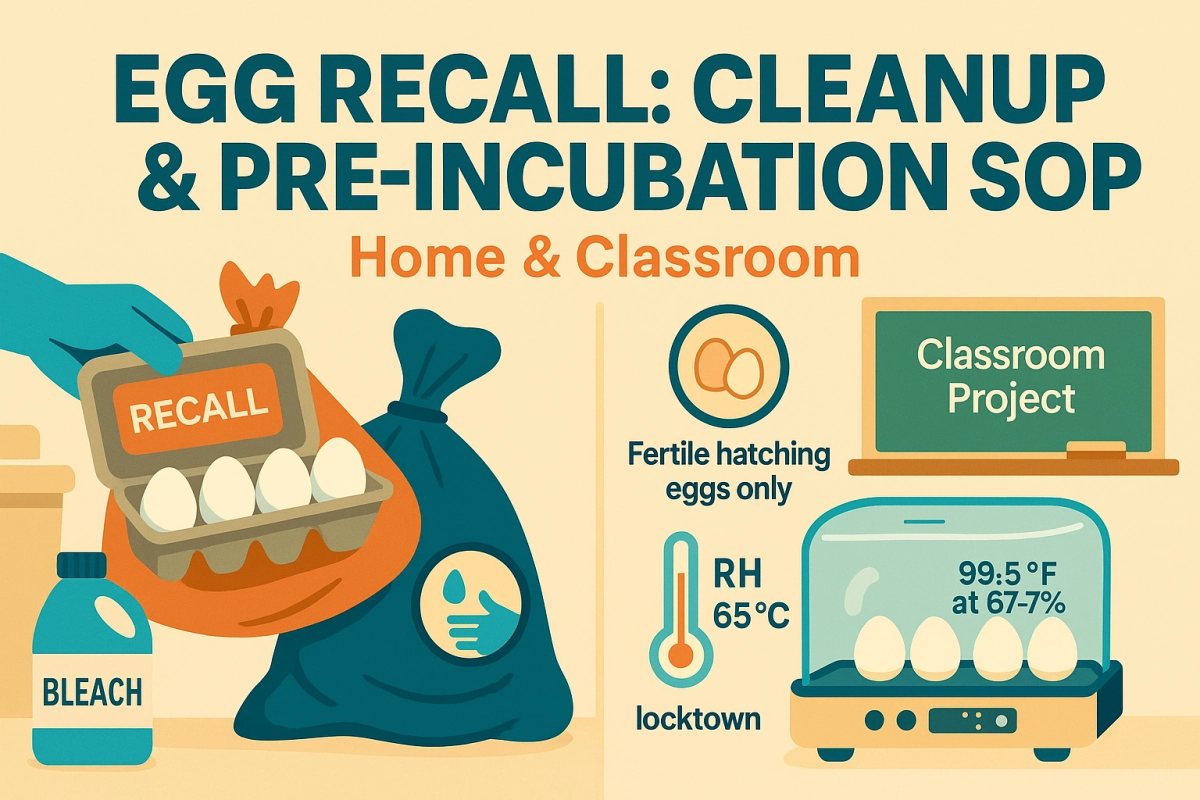
A quick, print-friendly workflow for families and teachers: how to verify recalled egg cartons, clean up safely with label-aligned sanitizer parameters, and reset a hygienic space if you also hatch eggs at home or in class. Sources are listed as text only. Follow product labels and local rules.
Step 0 — Verify the recall (carton check)
Conclusion: A recall match is a carton match. If your carton matches the identifiers, treat it as recalled.
- Match the brand, carton size, sell-by or best-by date, and UPC against the latest federal notice.
- If it matches, do not eat, cook, sell, or serve the eggs.
- Seal the carton in a clean bag to isolate leaks. Choose discard or return per retailer policy.
- Avoid composting recalled eggs.
Tip card: What to photograph before you throw it out
- Photo 1: UPC and carton front panel.
- Photo 2: sell-by or best-by date line.
- Photo 3: any plant or handler code printed on the carton.
These three photos let you confirm a match later if the notice is updated or your school needs documentation.
2025 update: Egg advisories often use date windows and code lines. Here are common identifier patterns from 2025 notices. Use them as examples, not as a complete list.
- Plant or carton code: some 2025 notices highlighted specific plant numbers or carton codes as primary identifiers.
- Date windows: several 2025 egg notices used sell-by or best-by ranges rather than a single date.
- UPC match: advisories may list multiple UPCs for the same producer across different store brands.
Always confirm with the current CDC or FDA notice. If any field is missing, treat the carton as unknown and do not serve it.
Home SOP — 10-minute cleanup workflow
Conclusion: Remove the recalled eggs first. Cleaning removes soil. Sanitizing reduces germs left behind.
- Bag and remove recalled eggs. Keep shell fragments contained.
- Wash hands with soap and warm water for at least 20 seconds.
- Empty the fridge zone that stored the eggs. Move food to a cooler.
- Wash surfaces with hot, soapy water. Wipe dry.
- Sanitize using one option below. Keep surfaces wet for the full contact time.
- Rinse only if the label instructs, then air-dry. Reload food.
- Clean tools. Prefer disposable towels for this job.
- Final handwash and wipe door handles, switches, and trash-bin lid.
Do not attempt to incubate recalled eggs or grocery-store eggs. Use fertile hatching eggs from reputable breeders or hatcheries.
Sanitizer parameters (ppm & contact time)
Cause and effect: If you sanitize over dirt, the sanitizer can fail. Cleaning first raises sanitizer performance.
Chlorine (unscented household bleach) — food-contact sanitizing
Conclusion: Aim for about 200 ppm on cleaned surfaces, then keep it wet for at least 1 minute.
- Target: about 200 ppm available chlorine for post-recall shelves and drawers.
- Contact time: at least 1 minute with the surface visibly wet.
- Mixing examples: 5–6% bleach: 1 Tbsp per 1 gal. 8.25% bleach: 2 tsp per 1 gal. Use chlorine test strips if you have them.
If you mix stronger than intended, follow the label for any rinse step. Do not mix bleach with other cleaners.
Quaternary ammonium compounds
Conclusion: Follow the label concentration and verify with test strips when possible.
- Typical range: 200 to 400 ppm at label dilution.
- Contact time: about 30 seconds, or per label.
- Record it: product name, dilution method, and contact time.
Iodine solutions
Conclusion: Use label strength and keep contact time consistent.
- Typical range: 12.5 to 25 ppm at label dilution.
- Contact time: about 30 seconds, or per label.
- Note: iodine can stain. It is less common in home kitchens.
Gloves, ventilation & waste disposal
Classroom add-on — teacher controls
Immediate steps
- Isolate the carton in a sealed bag. Store away from students.
- Notify administration per school policy. Arrange discard or return.
- Post a temporary “Do Not Touch” sign on the fridge or cabinet.
- Run the same wash → sanitize → dry sequence as at home.
Hygiene & supervision
- Students do not handle raw eggs and do not mix chemicals.
- Use products suitable for schools and food-contact surfaces. Follow label contact time and rinse directions.
- Log the cleanup in project notes to support accountability and learning.
Tip card: Classroom recordkeeping in three lines
- Carton match: brand, UPC, date line, and code line.
- Cleanup: cleaner used, sanitizer used, contact time used.
- Reopen: who cleaned, when cleaned, when the fridge area was reopened.
Pre-incubation hygiene checklist (homes & classrooms)
Choose the right eggs
- Fertile hatching eggs only from reputable breeders or hatcheries.
- Store large-end up in cool conditions. Set within 3 to 10 days of lay.
- Pick clean, intact shells. Discard cracked eggs and heavily soiled eggs.
- Learn the basics: Beginner’s Egg Incubation Guide, Day 0–21 Walkthrough
Clean gear, then stabilize
- Clean → Disinfect → Dry the incubator and tools before every batch.
- Pre-run the unit to stabilize temperature and humidity before setting eggs.
- Use a clear humidity plan so membranes stay flexible at hatch: Temperature and Humidity Guide
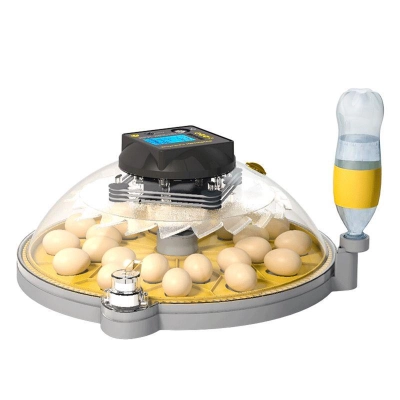
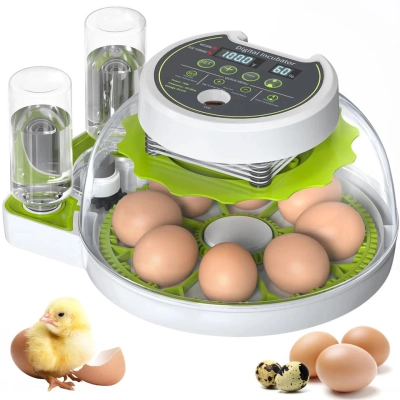
- For hands-off turning and steadier classroom routines, use an auto-turn dual-motor incubator for classroom hatch projects.
Helpful EggBloom links
• All Egg Incubators
Use recalled-egg SOPs for food safety. Use fertile hatching eggs for incubation projects.
Sources (text-only; no external links)
- CDC — Salmonella outbreak and recalled eggs notices (2025 updates) — carton identifiers, date windows, and what to do.
- FDA — Outbreak investigation linked to eggs (June 2025) — investigation updates and product identifiers.
- FDA — Recalls, Market Withdrawals, and Safety Alerts — recall listings and updates.
- FDA — Egg recall advisories (2025) — best-by ranges and UPC-based identification.
- CDC — Cleaning your refrigerator after a food recall — consumer cleanup steps.
- USDA FNS — USDA Foods recall resources — school and agency recall workflow references.
- eCFR Title 21 §178.1010 — Sanitizing solutions — permitted substances and conditions for food-contact surfaces.
- US EPA — Label compliance for disinfectants and sanitizers.
Follow your product label and local or state rules. Where guidance differs, defer to the stricter requirement.
FAQ
What bleach ratio gives about 200 ppm for home kitchen surfaces?
For 5–6% bleach, use 1 Tbsp per 1 gallon of water. For 8.25% bleach, use 2 tsp per 1 gallon. Keep the surface wet for ≥1 minute and air-dry unless the label requires a rinse. Verify with chlorine test strips.
Why do some guides say 50–100 ppm?
That range comes from Food Code sanitizing steps used in retail and foodservice. Home post-recall cleanup aims for a simple method that stays wet long enough to work. About 200 ppm with at least 1 minute contact is easier for consumers to execute consistently.
Do I need gloves and ventilation?
Yes. Wear disposable gloves during cleanup and wash hands after removal. Keep the area well-ventilated with open windows or a fan.
Can I hatch grocery-store eggs?
No. Store eggs are handled and refrigerated for eating and are typically not fertile. Use fertile hatching eggs from reputable breeders or hatcheries.
Data authenticity note: This SOP is a practical workflow for home and classroom hygiene. Confirm the latest federal notice for carton identifiers, and follow product label contact times and rinse directions.

0 Comments