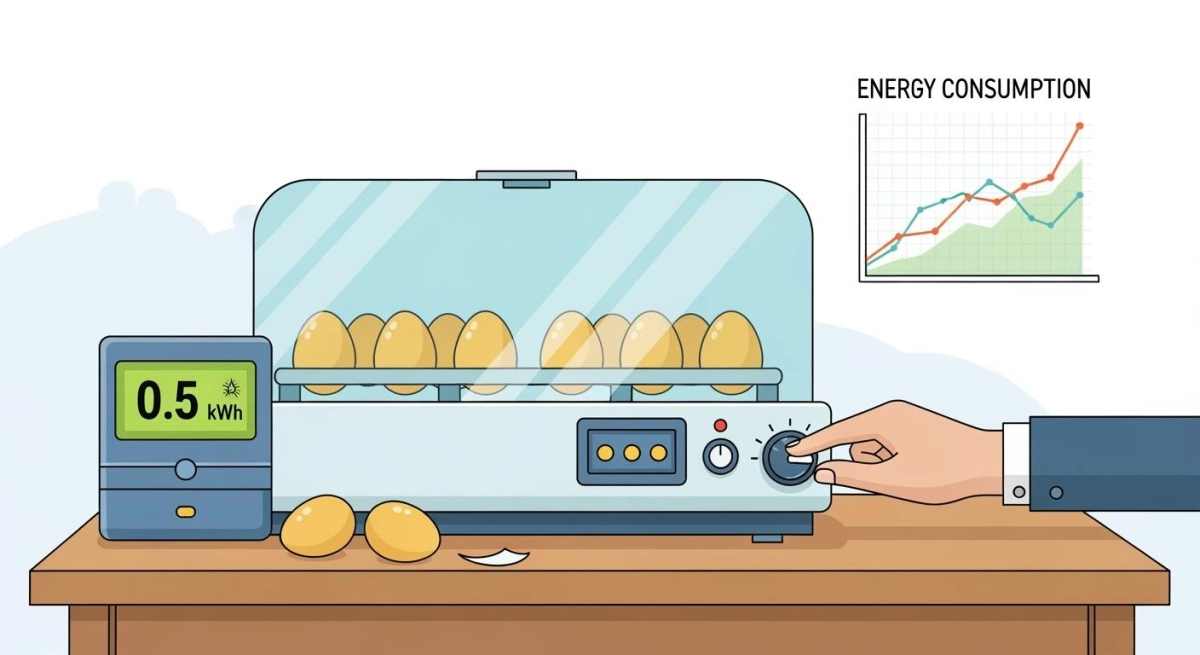
Wondering how much electricity an egg incubator uses? As a practical rule of thumb, a small desktop unit averages about 0.29 kWh per day, while a large cabinet model can average around 5.40 kWh per day. Over a 21-day chicken hatch, that’s roughly $1 to $20 at typical U.S. rates. Your actual cost depends on the model, local electricity prices, and room conditions. See the reference ranges below.
|
Incubator Type |
Average Power Consumption (Watts) |
|---|---|
|
Small |
12–45 |
|
Large |
100–250 |
Key Takeaways
-
Small incubators average about 0.29 kWh per day; large cabinet units can average near 5.40 kWh daily. A 21-day cycle typically costs ~$1–$20 at $0.175/kWh.
-
The heater is the main draw. Place the incubator in a room with stable temperature to reduce heater duty cycle and energy use.
-
To estimate cost: Average Power (W) × 24 × Days ÷ 1000 = kWh; then kWh × local rate = cost.
-
Minimize lid openings to prevent heat loss and unnecessary re-heating.
-
Choose well-insulated models with automatic egg turners to stabilize conditions and reduce manual errors.
Egg Incubator Power Sources
An incubator’s subsystems share the load. Understanding where power goes helps you optimize use.
Heating & Thermostat
The heater maintains target temperature and consumes the most electricity. Small incubators typically average about 12–45 watts. Medium models average around 60 watts. Large cabinet incubators average roughly 150–300 watts. The thermostat cycles the heater based on readings; colder rooms increase heater runtime.
Tip: Use a stable room and avoid drafts. Lower ambient swings mean less heater work and steadier kWh.
Illustrative typical vs. maximum values:
|
Incubator Type |
Typical Power Consumption (W) |
Maximum Power Consumption (W) |
|---|---|---|
|
Small |
12 |
— |
|
Medium |
60 |
— |
|
Cabinet |
150–300 |
— |
|
Foam Box |
Varies by design |
— |
Fan, Turner, Humidifier, Electronics
Fans even out temperature; turners rotate eggs briefly; humidifiers add moisture during dry spells; displays/alarms draw very little. These subsystems add small loads compared with the heater but improve stability when used correctly.
-
Fans add a few watts and promote uniform conditions.
-
Egg turners run intermittently.
-
Humidifiers work harder in dry rooms.
-
Displays and alarms have minimal impact.
Knowing each subsystem’s role helps you adjust the room and routine to save energy without compromising development.
Understanding Watts and Usage
Rated vs. Typical Power
Incubators have a rated (maximum) power on the label and a lower typical (average) power during normal cycling. Use rated power to estimate an upper bound; use measured daily average for realistic kWh and cost. If only heater wattage is listed, treat it as the instantaneous maximum.
For accurate planning, measure 24-hour average power with a plug-in meter or smart plug, then base your cost estimate on that average rather than the maximum.
Tip: Rated power shows the ceiling; typical power reflects day-to-day cost.
Power Ranges by Incubator Size
Different sizes consume different amounts. “Monthly Cost ($)” below reflects a typical 21-day chicken cycle at ~$0.175/kWh.
Here is a table with wattage ranges for common incubators:
|
Incubator Type |
Wattage Range (Watts) |
Monthly Cost ($) |
|---|---|---|
|
30–45 |
3–5 |
|
|
Medium (30-egg) |
60–70 |
6–8 |
|
Large (100+ egg) |
100–250 |
10–25 |
|
Energy-efficient |
30–40% less than older designs |
N/A |
You can see the differences in this chart:
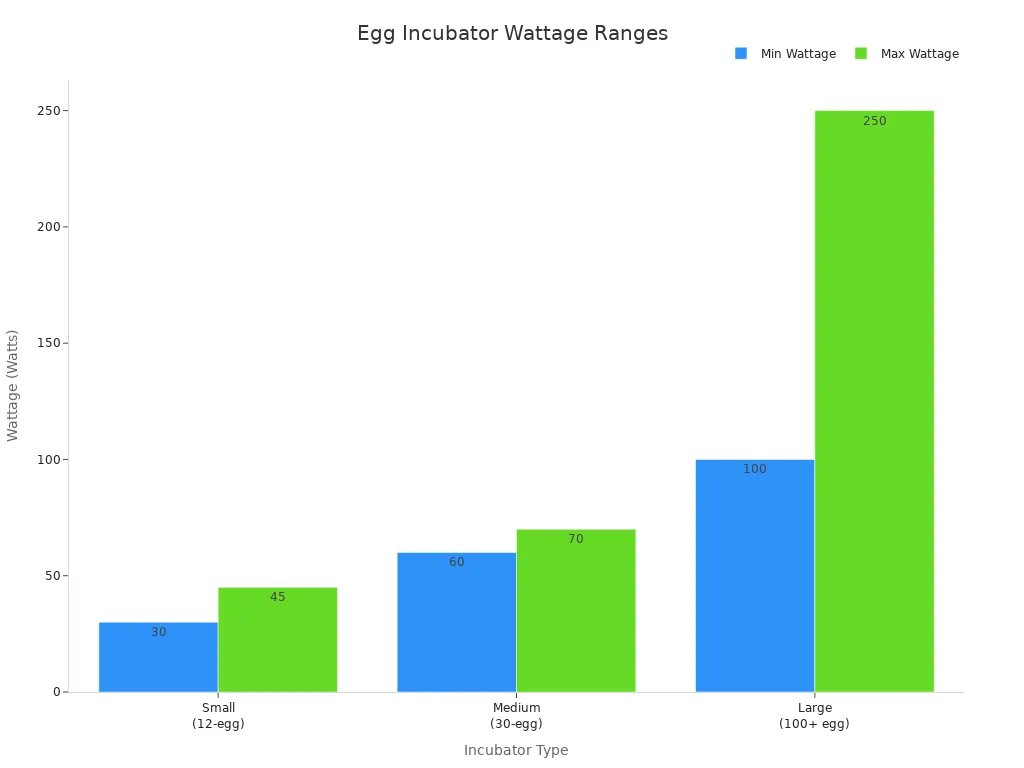
To find your incubator’s usage, read the label or manual for wattage (or heater wattage), then measure a full-day average. Use that figure for your cost estimate.
Calculate Egg Incubator Electricity Cost
kWh and Cost Formula
Estimate electricity use with a consistent method. Find average power (W), multiply by 24 hours and by the number of days, divide by 1000 for kWh, then multiply by your local rate.
Tip: If your utility rate is unknown, use the U.S. average of $0.175 per kWh as a placeholder.
Steps:
-
Find the average power (W) of your egg incubator.
-
Multiply by 24 hours per day.
-
Multiply by the number of incubation days (e.g., 21 days for chickens).
-
Divide by 1000 to get total kWh.
-
Multiply kWh by your local rate to get total cost.
Formulas:
kWh = Average Power (W) × 24 × Number of Days ÷ 1000
Cost = kWh × Local Electricity Rate
Example Calculations
Examples below use a 21-day cycle at $0.175/kWh.
|
Incubator Size |
Average Power (W) |
Daily kWh |
21-Day kWh |
Total Cost ($) |
|---|---|---|---|---|
|
Small |
12 |
0.29 |
6.05 |
1.06 |
|
Medium |
60 |
1.44 |
30.24 |
5.29 |
|
Large |
225 |
5.40 |
113.40 |
19.85 |
A small desktop unit uses far less energy than a large cabinet model. If you run a medium unit, expect about $5 per cycle under the given assumptions.
Note: Your results vary with ambient temperature, model efficiency, and local rates. Replace the example rate in the formula to match your utility.
Example for a medium incubator:
-
Average Power: 60 W
-
Daily Usage: 60 × 24 ÷ 1000 = 1.44 kWh
-
21-Day Usage: 1.44 × 21 = 30.24 kWh
-
Total Cost: 30.24 × $0.175 = $5.29
Use the same approach for any incubator by substituting your own measurements and rate.
Measure Your Own Usage
Power Meter Monitoring
Confirm actual consumption with a plug-in power meter or smart plug. Connect the meter, run for 24 hours without changes, and record kWh for that period.
Steps:
-
Place the power meter in the outlet.
-
Plug the incubator into the meter.
-
Let it run for a full day.
-
Record the kWh reading.
Tip: Keep room temperature near 74–80°F, avoid frequent lid openings, and use warm refill water to reduce re-heating.
Average Power Recording
Multiply daily kWh by incubation days (e.g., 21) and by your local rate to estimate total cost. If your measurement differs from the estimate, check for cold rooms, frequent lid openings, blocked ventilation, or refills with cold water.
-
Colder ambient = longer heater runtime.
-
Lid openings = rapid heat loss.
-
Ventilation issues = uneven conditions and inefficiency.
-
Cold refills = temporary temperature drop and extra heating.
Keep a simple log of temperature, humidity, turning schedule, and refills. Consistent records make it easier to spot trends and fix issues.
Note: If measured usage aligns with your estimate, your setup is stable. If not, use your log to locate the cause.
Lower Your Egg Incubator Energy Bill
Efficient Operation Tips
Adopt small habits that protect stability and reduce waste:
-
Place the incubator in a steady-temperature room, away from windows, vents, and direct sun.
-
Open the lid only when necessary.
-
Use refill water close to incubator temperature.
-
Prefer external refill ports or automated humidification when available.
-
Clean the fan, air channels, and water pans routinely to keep airflow efficient.
-
Keep vents clear for reliable heat and humidity distribution.
-
Calibrate sensors and thermostats before each batch.
-
Check door gaskets and electrical parts; a tight seal reduces heat loss.
Tip: Moderate loading improves thermal stability, but do not block airflow.
Quick guide to common scenarios:
|
Scenario |
Solution |
|---|---|
|
Room temperature swings |
Move to a more stable room |
|
Frequent lid openings |
Use external refill or automated humidifier |
|
Fan is noisy or weak |
Clean or replace the fan |
|
Humidity drops fast |
Check water pans and use warm water |
|
Heat loss through walls |
Add insulation or fix leaks |
Choosing Energy-Saving Models
Look for designs with better insulation, sealed lids, and external refill ports. Newer models often reduce energy use compared with older designs.
Where solar power is practical, a solar-assisted setup can offset utility costs in sunny regions. Prioritize consistent internal conditions over aggressive energy savings.
Features that support efficient operation:
|
Feature |
Description |
|---|---|
|
Energy Efficiency |
Lower average power than legacy designs |
|
Automatic Egg Turner |
Reduces openings and keeps rotation consistent |
|
Precise Humidity Control |
Maintains RH with fewer fluctuations |
|
Quick checks without opening the lid |
|
|
Easy Maintenance |
External water ports and smooth surfaces |
Energy use changes with the seasons. In cooler months, your incubator often uses more energy due to greater room-to-setpoint difference; in warmer, stable rooms it uses less.
By combining steady room conditions with practical features, you can control energy costs while maintaining healthy incubation.
In summary, a small desktop incubator can cost about $1 per 21-day cycle under typical U.S. rates, while a large cabinet model can reach about $20. Key drivers include model efficiency, ventilation design, and insulation quality.
-
Efficient fan motors support uniform conditions.
-
Good ventilation design keeps temperature and humidity steady.
-
Strong insulation and tight seals help save more energy.
Use the formulas and tips in this guide to estimate your own costs and optimize your setup.
FAQ
How do I find my incubator’s power usage if the label is missing?
Use a plug-in power meter or smart plug, run for 24 hours, and record kWh. Base your cost estimate on that measured average.
Does room temperature affect electricity use?
Yes. Warmer, stable rooms reduce heater runtime; cold rooms increase it. Keep the unit away from windows and vents, and avoid direct sunlight.
Can I lower my energy bill without buying a new incubator?
Yes. Keep the lid closed when possible, use warm refill water, maintain clear vents and clean fans, and choose a room with stable temperature.
What is the best way to calculate my total cost?
Use this formula:kWh = Average Power (W) × 24 × Days ÷ 1000
Then,Cost = kWh × Local Electricity Rate
Substitute your own numbers for a realistic total.
Do all incubators use the same amount of electricity?
No. Small desktop units use less power than high-capacity cabinets, and newer designs tend to be more efficient. Always verify with a meter for your setup.
Data authenticity note: Figures and methods reflect industry practice, equipment manuals, and aggregated power-meter logs from routine use. Because ambient conditions, models, and utility rates vary, expect minor adjustments for your specific setup. No external links are provided.
References :
1. Industry practice and field logs .
2. Equipment manuals for forced-air and still-air incubators (various models and revisions).
3. Incubator power-meter records and duty-cycle notes.
4. Utility rate schedules and common residential tariff examples.

0 Comments