
Set the right humidity, watch weight loss, and lock down correctly to hatch healthier chicks.
Most home incubators don’t need complicated tricks—just a steady baseline, a simple weight-loss check, and a proper lockdown boost.If you use an egg incubator with humidity control, you still need one more thing: a second opinion at egg height. A simple incubator hygrometer helps you confirm that the eggs are feeling the humidity you think you are giving them. This guide shows you how to set, check, and adjust humidity without stress.
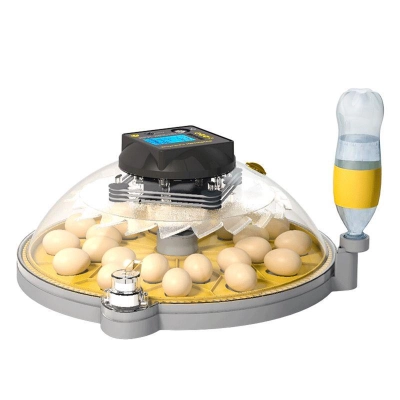
Humidity control depends on your incubator style (still-air vs. forced-air, size, ventilation). If you want a quick comparison, start with this egg incubator types guide.
What Humidity Do You Actually Need?
Most sources say to start with 45–50% RH humidity for the first 18 days, then increase to 65–70% RH in the last 3 days, which is called lockdown.
-
For chicken eggs, keep humidity at 45–50% for the first 18 days. Then raise it to 65–70% for hatching.
-
Some guides say use 45–50% RH until 3 days before hatching, then go above 65%.
You should watch egg weight loss and the air cell size: aim for ~11–13% loss by day 18.
Why it works: Moderate humidity lets moisture leave at a healthy rate so the air cell grows. Too low dries the membranes; too high makes chicks sticky and slow to hatch.
Simple Steps to Get It Right
Here are some steps to help you manage humidity for egg incubator success:
-
Keep humidity around 45–50% until day 18; then raise to 65–70% for lockdown.
-
Raise humidity to 65–70% at lockdown (day 19) or when pipping begins.
-
Change humidity based on your local weather to keep things steady.
-
Use warm water and increase water surface area (not just depth) to lift humidity.
-
Use an incubator hygrometer (a second, independent unit) at egg height to double-check the incubator’s display.
Baseline Settings (Quick Card)
-
Temperature (forced-air): 99.5°F (37.5°C); still-air: 101–102°F (38.3–38.9°C).
-
Humidity (chicken/quail): 45–50% (day 1–18) → 65–70% (lockdown).
-
Humidity (ducks/geese): 50–60% → 70–75% (lockdown).
-
Target weight loss: ~11–13% by day 18 (e.g., 60 g → about 52.8 g by day 18).
Temperature Safety: What Temperature Kills a Fertilized Egg?
Temperature problems can ruin a hatch faster than humidity problems. You should treat overheating as an emergency.
What temperature kills a fertilized egg?
A fertilized egg can die when the incubator runs even 1–2°F above the recommended setting for a short time. Some poultry guidance warns that this level of overheating can kill embryos within 15–30 minutes, depending on how high the temperature goes and the embryo stage.
You should also avoid big spikes like 105°F (40.6°C). One extension handout notes that running an incubator at 105°F for 30 minutes can seriously harm or kill embryos.
What is the ideal temperature for incubating eggs?
Most poultry references aim close to 100°F (37.8°C) for forced-air incubators, with a narrow acceptable band around 99–101°F.
For still-air incubators, a common target is 102°F, and the thermometer should read at the top of the eggs (egg height).
Short warning line you can keep bold: High temperatures hurt faster than low temperatures.
How to Prepare Your Incubator
-
Set temperature to 99.5°F (37.5°C) for forced-air models (or 101–102°F / 38.3–38.9°C for still-air models).
-
Fill the water tray to reach the target humidity of 45–50% (ducks/geese 50–60%).
-
Run the incubator for at least 24 hours to check stability.
-
Gather all eggs and record their starting weight.
-
Place sensors at egg height.
Tip: Always check the room temperature and humidity before starting. A very dry room may require a slightly higher baseline (±5%) to hold steady.
Recommended Ranges at Lockdown
Lockdown is the final 3 days. Higher humidity at this stage helps keep the chick membrane moist enough to allow the chick to breathe and prevents the membrane from drying out. You should avoid opening the incubator unless absolutely necessary, because each time you open it, humidity drops quickly.
Here is a table showing the recommended humidity ranges for different types of eggs during lockdown:
|
Type of Egg |
Humidity Range (First 18 Days) |
Humidity Range (Last 3 Days) |
|---|---|---|
|
Chicken Eggs |
45–50% |
65–70% |
|
45–50% |
65–70% RH |
|
|
Turkey Eggs |
45–50% |
65–70% RH |
You should always check the weight loss of your eggs before raising humidity. If your eggs have lost 13% or more of their starting weight by day 18, you’re on track.
Ventilation Tips
Ventilation is just as important as humidity during lockdown. Chicks need oxygen to hatch, and a small amount of ventilation is necessary. However, avoid opening the incubator door more than necessary, because each time you open it, humidity drops quickly.
Here are some tips for managing ventilation and humidity for egg incubator success:
-
Monitor the humidity level closely. Use a digital hygrometer at egg height.
-
Stop turning eggs three days before hatching. Position eggs with the air cell up.
-
Open air vents slightly to allow fresh air in, but Avoid opening the lid during lockdown; increase water surface area or use external fill ports.
-
Add warm water to the incubator to boost humidity quickly without dropping temperature too far.
How to Add Water Without Opening the Incubator
You can keep humidity steadier when you refill from the outside.
If your incubator has an external water filling port:
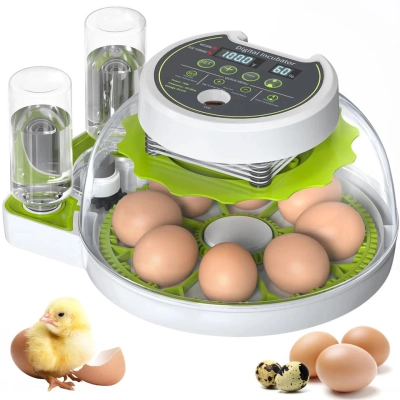
You should pour water in through the external port so the water goes into the internal water pot(s).
You should fill water pot “A” during days 1–18, and you should fill both “A” and “B” for lockdown on many common models.
You should pour slowly and stop around 2/3 to 3/4 of the pot height to reduce spills and sudden humidity spikes.
You should wait 2–3 hours after refilling for humidity to stabilize before you make another adjustment.
If your incubator does not have an external fill port:
You should pre-fill water to your planned baseline before you start incubation. You should keep any lid opening short and rare during lockdown, because humidity can fall sharply and needs time to recover.
How to Measure Humidity Accurately
To get accurate readings, place the sensor at the height of the eggs. This is the most important step: if the sensor is too high or too low, you won’t be measuring the air the eggs feel.
-
Use at least one independent hygrometer to confirm the incubator’s display.
-
Calibrate sensors before each batch if possible (e.g., salt test ~75% RH).
-
Keep sensors away from direct airflow or heating elements.
What If Your Readings Seem Wrong?
Common issues & quick checks
-
Reading too low? Check if the water channels are filled and increase surface area with a sponge.
-
Reading too high? Reduce exposed water surface or slightly increase ventilation.
-
Sensor mismatch? Trust the calibrated unit placed at egg height.
-
Room is very dry? Expect faster moisture loss; adjust baseline by ~±5% to keep weight-loss on track.
CO₂, Ventilation & Practical Reality
Some charts link specific CO₂ percentages to higher hatch rates, but most home incubators cannot measure or control CO₂. Focus on steady humidity and sensible airflow instead.
|
Note |
Guidance |
Why |
|---|---|---|
|
CO₂-specific targets removed |
Focus on steady RH: 45–50% early; 65–70% at lockdown |
Household incubators lack CO₂ control; ventilation varies by model |
Troubleshooting by Symptom
|
Symptom |
Likely Cause |
What to Try |
|---|---|---|
|
Sticky chicks, slow hatch |
RH too low in lockdown; lid opened often |
Hold 65–70% in lockdown; minimize opening; add warm water/sponge to boost surface area |
|
Large air cell too early |
RH too low early; very dry room |
Raise baseline to 45–50% (ducks/geese 50–60%); check room humidity; reduce ventilation |
|
Small air cell by day 18 |
RH too high early |
Lower early RH next time; aim for ~11–13% weight loss by day 18; candle at day 7/14/18 |
FAQ
Do I always need 65–70% at lockdown? For most chicken/quail batches—yes. If your room is extremely dry, you may need the higher end of the range.
Which matters more, humidity or weight loss? Use weight loss as the anchor (target ~11–13% by day 18), and nudge humidity to get there.
My incubator says 50% but my sensor says 45%—which is right? Trust the calibrated sensor placed at egg height.
How does humidity affect the egg membrane during hatching?
Humidity controls how quickly an egg loses moisture and whether the membrane stays soft. If humidity is too low, the membrane becomes dry and tight, which can shrink-wrap the chick. If humidity is too high, the membrane stays sticky and slows the chick’s ability to turn and hatch.
What happens if the humidity is too low during incubation?
Low humidity makes the egg lose water too quickly, creating a large air cell and a dry membrane. This often leads to weak chicks, shrink-wrapping, difficult hatches, or late dead-in-shell losses.
What are the ideal humidity levels for chicken incubation and hatching?
Most incubators do well at around 45–50% humidity during the main incubation period. For the final three days of lockdown, humidity should be increased to about 65–70% to prevent membrane drying and to support clean hatching.
What temperature kills a fertilized egg?
A fertilized egg can die when temperature runs 1–2°F above the recommended setting for a short time. Some extension guidance warns this can happen within 15–30 minutes, depending on how high the temperature goes and the embryo stage.
A spike like 105°F (40.6°C) is also dangerous. One extension handout notes that 105°F for 30 minutes can seriously harm or kill embryos.
What is the ideal temperature for incubating eggs?
Many poultry references target about 100°F for forced-air incubators (often treated as 99–101°F as a tight operating range).
A still-air incubator is often run at 102°F, and you should measure at egg height.
How to add water without opening the incubator?
You can refill through an external water filling port on supported models, which lets you add water to the water pot(s) from outside. You should pour slowly to about 2/3–3/4 full and then wait 2–3 hours for humidity to stabilize.
Final Checklist
-
Temperature steady: 99.5°F forced-air (101–102°F still-air).
-
Humidity steady: 45–50% (day 1–18), then 65–70% (lockdown).
-
Candle day 7/14/18; aim for ~11–13% total weight loss by day 18.
-
Avoid sustained <35% humidity; for most home incubations keep 45–50% to prevent over-drying.
-
During lockdown, avoid opening the lid; use external fill ports or increase water surface area.
With a steady baseline and simple checks, humidity management becomes easy—even for first-timers.
For more step-by-step help, see our full guide to humidity.

0 Comments