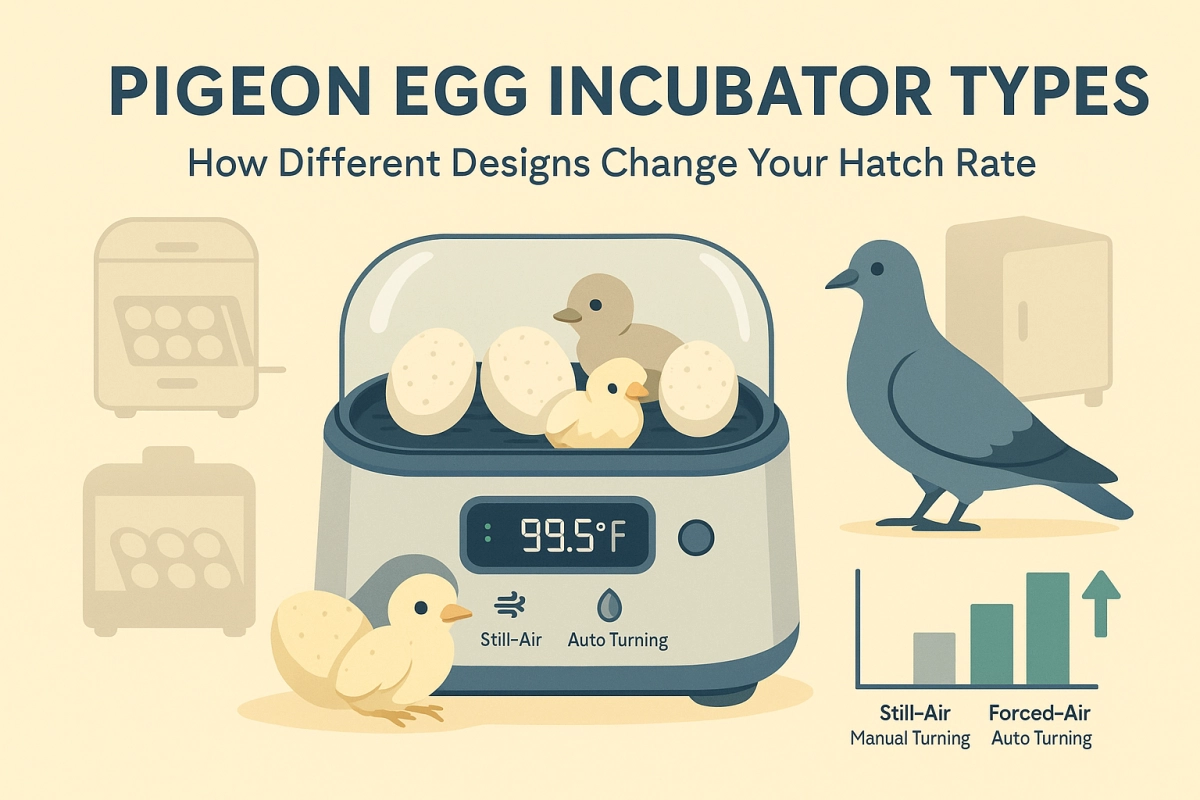
If you hatch pigeon eggs more than once or twice, you quickly learn that not every pigeon egg incubator performs the same. Two keepers can run similar eggs at “99.5°F” and get very different results. The gap usually isn’t luck – it’s incubator design, how forgiving it is, and how easy it makes day-to-day management.
This guide is written for small-scale pigeon keepers, racing and show breeders, and classrooms who want predictable hatches instead of guessing. We’ll look at the main incubator types, how their design really affects hatch rate, which setups fit different lofts and schedules, and what to do if you’re working with a basic model you already own.
Key Takeaways
-
Incubator type doesn’t magically guarantee high hatch rates, but it does decide how forgiving your setup is when temperature, humidity, or turning aren’t perfect.
-
Forced-air incubators with reliable automatic turning usually give more consistent pigeon hatch rates than still-air, manual models – especially for new breeders.
-
“Good” hatch rates for pigeon eggs are often in the 70–85% range with healthy parents and solid management. Reaching 90%+ takes well-matched equipment and tight technique, and no incubator can promise 100%.
-
Choose incubator types based on flock size, how often you hatch, and how much daily hands-on time you honestly have – not just capacity or price.
-
You can often add 10–20 percentage points to your hatch rate just by improving calibration, location, humidity control, and turning habits before you consider upgrading.
Why Your Pigeon Egg Hatch Rate Depends on the Incubator You Use
What Counts as a “Good” Pigeon Egg Hatch Rate?
Before you compare incubator types, it helps to set realistic expectations. Even with the best machine, hatch rates are never 100%. Fertility, parent health, egg handling, storage time, sanitation, and genetics all matter just as much as your incubator.
For many small-scale pigeon breeders who are still refining their routine, a typical hatch rate falls somewhere around:
|
Incubation Method |
Realistic Hatch Range* |
|---|---|
|
Broody pigeon parents |
Often 60–85% depending on pair health and conditions |
|
Well-managed incubator |
Often 70–90% with good eggs and steady conditions |
*These are common ranges from real lofts, not guarantees. Individual clutches can fall outside these numbers.
The important point: a good incubator can match or modestly improve on natural hatches, but it cannot fix poor eggs or bad handling. What it can do is make temperature, humidity, and turning more repeatable – so your skills compound instead of resetting every clutch.
Why Incubator Design Matters More Than Just the Temperature Number
Many keepers say, “I set 99.5°F, so why are my pigeon eggs still hatching late or weak?” The problem is that the number on the screen is only part of the story. Incubator design decides:
-
How even the temperature really is across the tray (hot and cold spots).
-
How stable humidity stays when the room changes or you open the lid.
-
How reliably eggs are turned, and how much human error creeps in.
-
How well fresh air circulates without chilling the eggs.
-
How much work you must do every single day to keep conditions on target.
Two incubators set to the same temperature can produce very different results because one has better airflow, less temperature gradient, automatic turning, and tighter seals. Over 17–19 days, those small differences add up to a big gap in hatch rate and chick quality.
If you want a day-by-day walkthrough of settings, candling, and lockdown on top of choosing the right machine, you can follow EggBloom’s complete step-by-step pigeon egg hatching guide.
The Main Pigeon Egg Incubator Types (and What They’re Built to Do)
Still-Air vs Forced-Air Incubators for Pigeon Eggs
Still-air incubators have no fan. Warm air naturally rises, so the top of the chamber runs hotter than the bottom. Forced-air incubators use a small fan to mix the air so every egg feels roughly the same temperature.
For pigeon eggs, this design difference is crucial:
-
Still-air units can work well, but there is a vertical temperature gradient. You must place the thermometer at egg-top height and accept that small placement errors can shift embryo temperature enough to cause early or late hatches.
-
Forced-air units are more forgiving. Air mixing reduces hot and cold spots, which makes it easier to keep most eggs in the “good” temperature window even if the room isn’t perfect.
If you are new to artificial incubation or your room temperature swings, a forced-air incubator is usually a safer choice for steady pigeon hatch rates.
Manual vs Automatic Turning: How Much Work Do You Want to Do?
Pigeon embryos need regular turning so they don’t stick to the shell membranes and so blood vessels develop evenly. In practice, that means tilting or rolling the eggs several times a day from day 1 until lockdown.
-
Manual turning can work well for disciplined keepers, but it adds several chores every day and increases lid openings. Missed turns and uneven timing are common causes of late-dead-in-shell chicks.
-
Automatic turning uses trays, rollers, or tilting racks that rock eggs on a schedule. This not only reduces human error, it also keeps the lid closed longer, which helps both temperature and humidity stability.
For occasional hatches with just a few eggs, manual turning may be fine. For repeated clutches, racing lines, or busy households, automatic turning is one of the simplest upgrades you can make to improve consistency.
Desktop, Cabinet, and Mini Models
Incubators also differ in size and layout. How you plan to use them matters just as much as the technology inside.
|
Incubator Type |
Best Fits |
|---|---|
|
Mini / classroom units |
Very small batches, STEM projects, simple first-time hatches |
|
Desktop / countertop |
Backyard lofts and small breeders hatching a few clutches a year |
|
Cabinet (multi-tray) |
Serious breeders running multiple pigeon lines or frequent batches |
Cabinet incubators shine when you routinely set many eggs and want every shelf to behave the same. For most small-scale pigeon keepers, a good forced-air desktop model with automatic turning is often the sweet spot between cost, capacity, and hatch rate stability.
How Incubator Design Really Changes Your Hatch Rate
Temperature and Humidity: Why Some Incubators Are More Forgiving
Pigeon embryos do best in a fairly narrow temperature window. Forced-air units typically run around 99.5–100.0°F (37.5–37.8°C), while still-air units need a slightly higher reading at egg height to reach the same embryo temperature. Humidity affects how much moisture the egg loses over time, which in turn shapes air-cell size and hatch quality.
|
Temperature Pattern |
Typical Effect on Hatch |
|---|---|
|
Stable around 99.5–100°F |
Most eggs hatch in a tight 17–19 day window with good chick strength |
|
Consistently a bit low |
Late, slow hatches; more large but weak chicks and late dead-in-shell |
|
Consistently a bit high |
Early hatches; smaller, stressed chicks and higher mortality risk |
Higher-end incubators don’t just show a more precise number – they usually hold that number far more steadily across the whole tray. That makes them more forgiving when the room is a little cool at night or you cannot check the display every few hours.
If you want exact ranges, examples, and calibration tips specific to pigeons, EggBloom’s pigeon egg incubation temperature guide walks through the details.
Turning and Ventilation: Small Design Details, Big Outcomes
Egg turning and fresh air are easy to underestimate. In practice:
-
Inconsistent or skipped turning encourages embryos to stick to the shell, increases late losses, and can leave you with a few strong squabs and many that never pip.
-
Poor ventilation creates pockets of stale, low-oxygen air. Embryos close to hatching need more oxygen; if it isn’t there, you see fully formed chicks that simply never leave the shell.
Incubators with built-in automatic turners and thoughtfully placed vents reduce the chance of these problems. Cheaper models often depend on you to crack lids or slide vents manually, which can accidentally dump heat and humidity just when chicks are pipping.
Newbie Mistakes Certain Incubator Types Make More Likely
Each incubator type has failure patterns that show up again and again:
-
Small still-air models often suffer from thermometers placed too high, so the readout looks fine while embryos are actually cooler than expected.
-
Manual-turn tabletop units invite skipped turns on busy days and extra lid openings that destabilize humidity.
-
Large, budget cabinets sometimes hide hot and cold spots between shelves, so one tray hatches well while another stalls.
A more advanced incubator cannot make bad eggs good, but it can remove many of the easy ways to sabotage a clutch – especially for new or very busy keepers.
Which Incubator Type Fits Your Loft, Flock Size, and Schedule?
Best Incubator Types for Small Backyard Pigeon Lofts
If you keep a modest loft and only set 8–20 pigeon eggs a couple of times a year, you probably do not need a huge cabinet incubator. What you do need is something simple, safe, and forgiving.
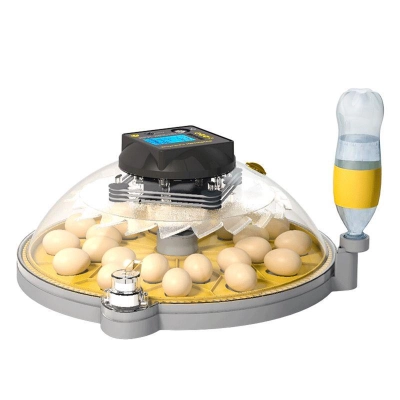
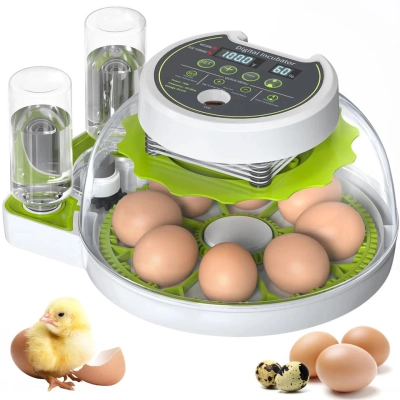
For most small lofts, a compact forced-air desktop incubator with automatic turning and clear lid strikes a strong balance between control and convenience. You can compare options designed specifically for this kind of use in EggBloom’s pigeon egg incubator collection.
If you want a ready-made setup that handles temperature, turning, and multi-species batches with minimal fuss, a model like EggBloom’s automatic egg incubator with three trays lets you organize pigeon eggs on dedicated trays while the machine manages the routine work.
For Serious Breeders: When a Cabinet-Style Incubator Makes Sense
If you race pigeons, breed for color or performance, or sell squabs and hatching eggs, your main concern is consistency. You are probably setting multiple clutches, sometimes from different lines, and cannot afford big swings in hatch rate from batch to batch.
In that case, a quality cabinet incubator with forced-air circulation, fine-grained controls, and automatic turning usually pays for itself over time. The extra capacity is less about “more eggs now” and more about:
-
Keeping different lines or age groups on separate trays.
-
Spreading risk across more eggs so one weak clutch doesn’t derail your plans.
-
Making settings and routines identical from batch to batch, so your notes and adjustments actually stack.
Classrooms and One-Off Hatches: Simple, Safe Choices
For school projects, youth groups, or a single “let’s watch eggs hatch” experience, the goals are a bit different: safety, visibility, and a reasonable chance of success without asking students to baby-sit the incubator all day.
A small forced-air incubator with auto-turning and a clear lid usually works best here. It lets children watch development without opening the lid constantly, and it keeps most of the critical controls in adult hands while still being easy to explain.
Getting Better Hatch Rates from the Incubator You Already Own
Simple Tweaks for Higher Hatch Rates
You might not be ready to upgrade right now – and that’s fine. Many pigeon keepers climb from 50–60% hatches into the 70–80% range just by tightening their process with the incubator they already have.
Focus on a few high-impact tweaks:
-
Calibrate temperature. Use an independent, trusted thermometer at egg-top height to confirm what your incubator display really means, then adjust the setpoint to hit the correct embryo temperature.
-
Choose the right location. Put the incubator in a room with a stable temperature, away from direct sun, drafts, and frequently opened doors. Most machines perform badly if the room swings all day.
-
Dial in humidity. Aim for a steady mid-range during most of incubation, then higher humidity at lockdown so membranes stay soft while squabs are pipping. Track air-cell size or note whether chicks look sticky or shrink-wrapped and adjust next time.
-
Clean between batches. Residual fluff, dried membranes, and dust increase bacterial load and can drag down hatch rates over time.
If your temperature readout jumps around more than you expect, the problem may be placement, calibration, or hardware – not just the eggs. EggBloom’s guide to troubleshooting incubator temperature fluctuations walks through how to diagnose and fix those issues step by step.
When It’s Time to Upgrade Your Incubator
At some point, you may realize you are doing everything right – good eggs, careful handling, notes every batch – yet your hatch rate still plateaus or swings wildly between clutches. That is often a sign that incubator design is now the limiting factor.
Common “time to upgrade” signals include:
-
You see hot and cold spots no matter how you rearrange eggs.
-
You constantly fight big temperature or humidity swings whenever the room changes a little.
-
Manual turning or frequent lid opening feels like a full-time job every time you set eggs.
-
Your hatch rate improves for one or two clutches after a big effort, then slips back as soon as life gets busy.
Upgrading won’t magically fix weak parent stock or poor egg storage, but for frequent pigeon hatches it often turns a fragile, stressful process into something boring and repeatable – and “boring and repeatable” is exactly what you want when you depend on healthy squabs.
FAQ: Pigeon Egg Incubators and Hatch Rate Problems
Can I use a chicken egg incubator for pigeon eggs?
Yes, many keepers successfully hatch pigeon eggs in chicken egg incubators. The key is support for small eggs (trays or rollers that prevent slipping), stable temperature, and enough turning frequency. Expect a bit more fine-tuning at first, and watch the edges of the tray for hot or cold spots.
Which incubator type is best for beginners who want reliable pigeon hatches?
For most beginners, a small forced-air desktop incubator with automatic turning is the safest bet. It handles the two hardest jobs – air mixing and turning – so you can focus on learning temperature, humidity, and candling without juggling as many variables at once.
How often should I turn pigeon eggs in an incubator?
If your incubator turns eggs automatically, follow the manufacturer’s schedule – frequent, gentle turns every hour or two are common. For manual setups, turning three to five times per day with a clear routine is usually enough. Stop turning during lockdown, the last 2–3 days before hatch.
Why does temperature stability matter so much for hatch rates?
Pigeon embryos are developing organs, bones, and circulation on a tight schedule. Repeated heat spikes or long cool dips interrupt that process and show up later as early embryo loss, late-dead-in-shell chicks, or squabs that hatch weak and slow. A stable incubator turns that risk into a much smaller one.
What should I check first if my pigeon hatch rate is low?
Start with the basics: verify temperature with a second thermometer, review humidity and turning habits, and be honest about egg quality and storage time. Make one or two changes per cycle, not ten, and keep simple notes. Over a few clutches, you’ll see a clear pattern – and you’ll know whether technique or incubator type is the next upgrade to tackle.
0 Comments