By winter, most hatches don’t fail because the eggs are “extra fragile.” They fail because we get extra involved. Cold weather makes every little interruption cost more—every lid opening dumps warm air, every “quick check” takes longer to recover, and every last-minute adjustment adds a swing.
If you’ve already worked through Part 1 (temperature swings) and Part 2 (humidity without overthinking), this is the final piece: building a process that keeps your winter hatch steady even when your house isn’t.
This isn’t about being perfect. It’s about reducing the chances for human-made mistakes—so your egg incubator can do its job without constant interruptions.
The Winter Reality: Every “Small Action” Has a Bigger Price
In warmer seasons, you can get away with more. In winter, the environment punishes extra handling:
- Open the lid for 15 seconds → temperature and humidity drop faster than you expect
- “Just one adjustment” → becomes an up/down cycle across the day
- Extra checking → turns into extra recovery time
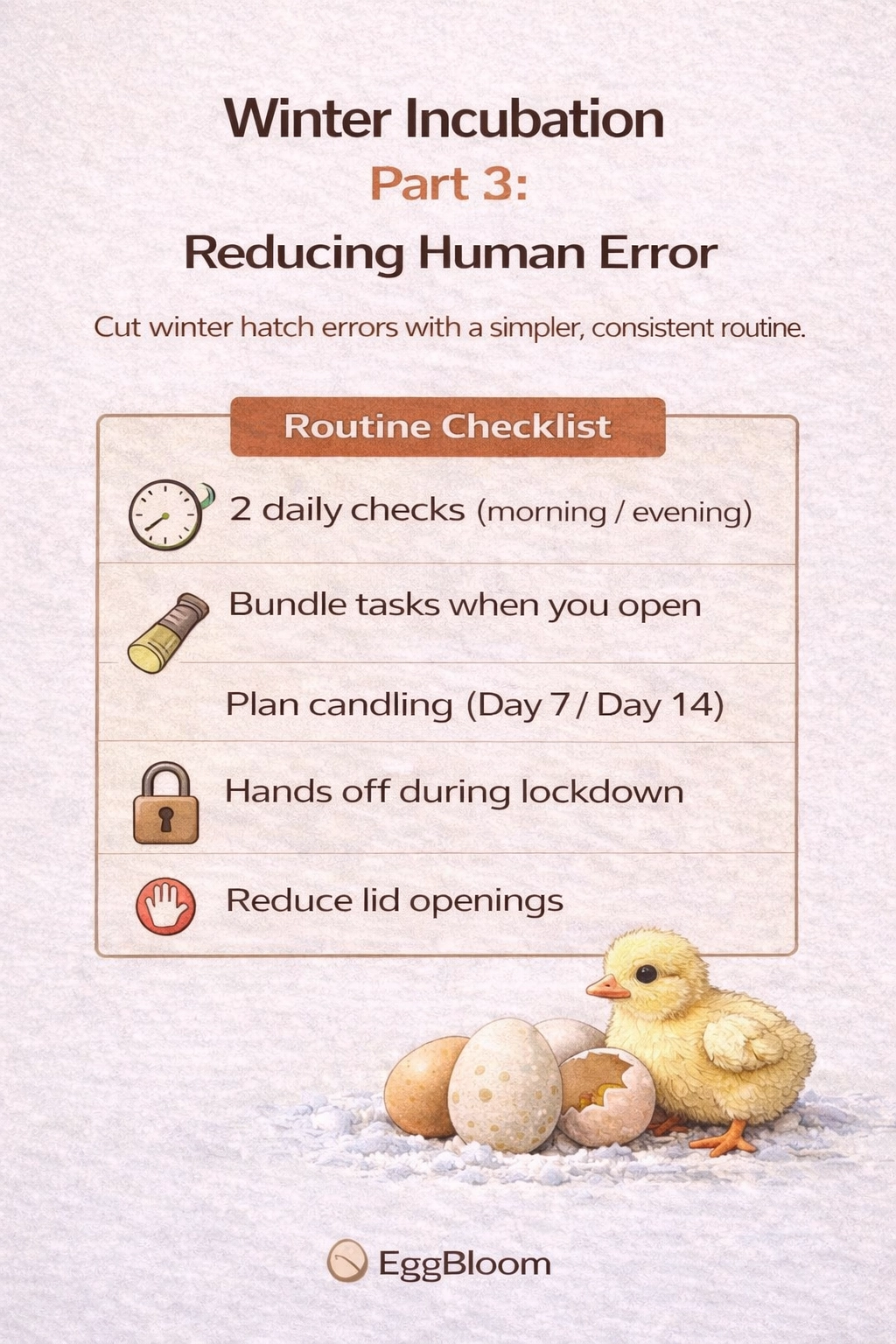
The goal is not to eliminate checking. The goal is to bundle your actions so you disturb the incubator less often.
The 5 Most Common Winter “Human Errors” (And What to Do Instead)
1) Checking too often because you’re nervous
I get it—winter hatching feels higher-stakes. But frequent checks are usually the thing that creates instability.
- Do instead: pick two daily check windows (example: morning and evening) and stick to them.
- Why it works: fewer disturbances, more consistent recovery patterns.
2) Making single-parameter decisions
A common pattern: “Temp dipped, so I raise the setting,” without considering that the room will warm later. Or “Humidity looks low,” without remembering you just opened the lid.
- Do instead: wait for readings to settle after any opening before reacting.
- Why it works: you stop chasing short-term noise.
3) Over-correcting after a cold night
Winter nights drop hard. It’s tempting to crank settings first thing in the morning.
- Do instead: verify your room conditions first, then give the incubator time to stabilize.
- Why it works: prevents daytime overshoot and repeated swings.
4) “Quick candling” that turns into repeated lid openings
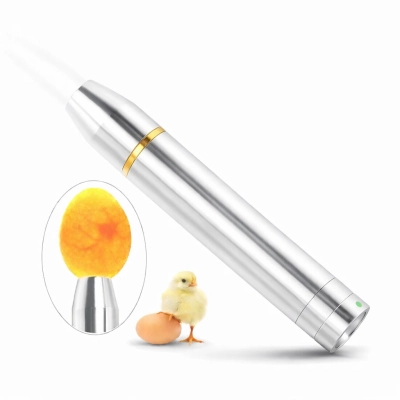
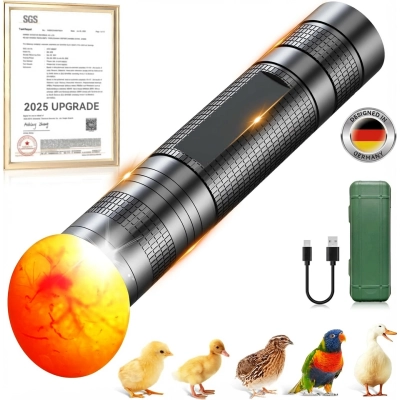
Candling can be useful, but winter is the season to keep it simple. The mistake isn’t candling—it’s candling too often, too long, or without a plan.
- Do instead: candle on a set schedule (not randomly) and prepare everything before opening.
- Why it works: you reduce open-time and avoid repeated disturbances.
5) Lockdown panic
Lockdown is where winter hatches get messy—because people try to “help” with extra tweaks. The air is dry, the room is cold, and each opening hits harder.
- Do instead: set your plan before lockdown and commit to fewer openings.
- Why it works: stable conditions beat constant “fixing.”
The “Bundle and Leave It Alone” Routine
This is the routine that made my winter hatches calmer. It’s not fancy—it’s just structured.
Daily routine (twice a day)
- Check display readings (no adjustments unless a trend is clearly off)
- Refill water only if your routine calls for it (avoid reactive topping off)
- Quick visual check through the window (if your unit has one)
Weekly routine (planned, not emotional)
- Candle once (if you candle at all), with everything ready before you open
- Log what you changed (so you don’t “double adjust” later)
This is how you keep a winter egg incubator stable without feeling like you’re babysitting it.
Why Fewer Lid Openings Is the “Secret Weapon” in Winter
If you take only one habit from Part 3, take this: reduce lid openings.
In winter, fewer openings means:
- more stable temperature recovery
- more stable humidity recovery
- less temptation to “fix” normal fluctuations
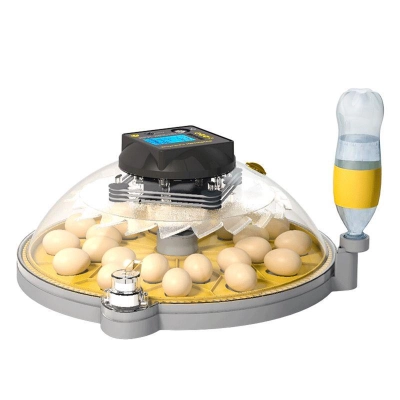
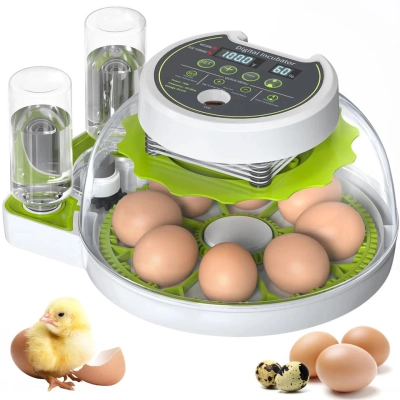
This is also why many winter hatchers prefer a setup that turns eggs automatically—less daily handling, fewer reasons to open. If you’re trying to simplify winter routines, an Automatic Egg Incubator can help you reduce the most common winter mistake: doing too much.
Winter Hatch Mindset: “Stable” Beats “Perfect”
Winter is not the season to chase perfection. It’s the season to create a system that holds steady when the room doesn’t.
- Stable placement beats a perfect setpoint in a bad location
- Simple routines beat constant micro-adjustments
- Fewer interventions beat “helping” at the wrong time
When I stopped trying to be the hero and started trying to be consistent, my winter results got more predictable—and hatch day got a lot less stressful.
Putting the Series Together
Here’s how the three parts connect:
- Part 1: reduce temperature swings by improving placement and avoiding constant adjustments
- Part 2: manage humidity with trend-based habits, not reactive changes
- Part 3: reduce human error by bundling actions and minimizing lid openings
If you apply all three, you’re not chasing perfect numbers—you’re building stability. And that’s the real winter advantage.
Data sources include mainstream poultry science research and university extension publications.



0 Comments