
There are many chicken egg incubators for sale today. Some look almost the same. Some promise very high hatch rates with a low price. It is hard to tell which ones are steady tools and which ones are risky toys.
This guide will help you choose a reliable chicken egg incubator for 2025. You will see what a good incubator should do, which beginner-friendly models make sense, where to buy them, and when the timing is in your favor. The goal is simple. You buy one good machine, you learn how it behaves in your home, and you feel calmer on hatch day instead of staring at the lid and worrying.
If you already know you want to shop now, you can look at the full collection of incubators we use and recommend. It gathers our main models in one place so you can sort by size, price, and features without bouncing between tabs: Chicken Egg Incubator collection.
For now, let’s slow down and talk through what a good incubator must do for your eggs and your chicks.
What a good chicken egg incubator should do
A good incubator takes the place of a steady broody hen. It keeps the eggs warm, lets them breathe, helps them lose just enough water, and turns them on a regular schedule. You do not need to remember a long list of settings. You only need to remember four main jobs: temperature, humidity, turning, and airflow.
Keep a steady, gentle temperature
The incubator must hold a warm and steady air temperature around the eggs. For chicken eggs, a common target in a forced-air incubator is about 99.5°F (37.5°C). A small swing for a short time is normal. A big swing that lasts for many hours can slow the chicks, make them weaker, or stop growth in part of the batch.
A clear digital display makes it easier to see what is going on without guesswork. A good incubator also reacts in a calm way when the room gets cooler or warmer, so the eggs do not feel sudden shocks. Many hatchers like to keep a simple backup thermometer inside the incubator to double-check the reading at egg level.
Hold the right level of humidity
Humidity is how wet or dry the air feels inside the incubator. As the chick grows, the egg needs to lose some water through the shell. That slow loss makes the air cell grow. Around hatch day, the chick breathes from that air cell before it breaks the shell.
If the air is too dry for many days, the egg can lose water too fast and the inner membrane can dry and cling to the chick. People often call this “shrink wrap.” If the air is too wet, the egg may not lose enough water and the air cell stays small. That can make hatching slow and hard.
A simple starting point that works for many chicken eggs in a forced-air incubator is about 45–55% humidity for the first 18 days, then around 65–75% for the last few days of hatch. A good incubator makes it easy to add water and to see a humidity number on the screen so you are not guessing all the time.
Turn the eggs on a regular schedule
In nature, a hen shifts and rolls her eggs many times each day. She does this so the embryo does not settle to one side and stick to the shell. Your incubator needs to copy that gentle movement during most of the 21-day chicken egg incubation period.
Some incubators use an automatic turner. They tilt or roll the eggs for you every few hours. Others expect you to open the lid and turn the eggs by hand three to five times a day. Manual turning can work, but it is easy to forget a turn on a busy day. For most first-time hatchers, an automatic turner makes life easier and keeps the schedule more even.
Turning usually stops around day 18 for chicken eggs. This is often called “lockdown.” At that point, the chick is getting into position for hatch, so you want the egg to stay still while you focus on temperature, humidity, and airflow.
Let fresh air move through the incubator
The chick inside the egg is alive. It uses oxygen and gives off carbon dioxide. The incubator must let fresh air come in and move gently through the space. At the same time, it should not blast cold air straight at the eggs.
Many modern incubators use a small fan to mix the air. This is called a forced-air design. It helps keep the temperature more even from corner to corner and from top to bottom. Still-air incubators do not have a fan, so the warm air rises and cooler air sits lower. Those models can work, but they are less forgiving and the correct temperature must be measured at the top of the eggs.
Good airflow plus the right ventilation openings help keep the air fresh, the temperature even, and the chicks safe as they grow and hatch.
Best chicken egg incubators for beginners (2025 picks)
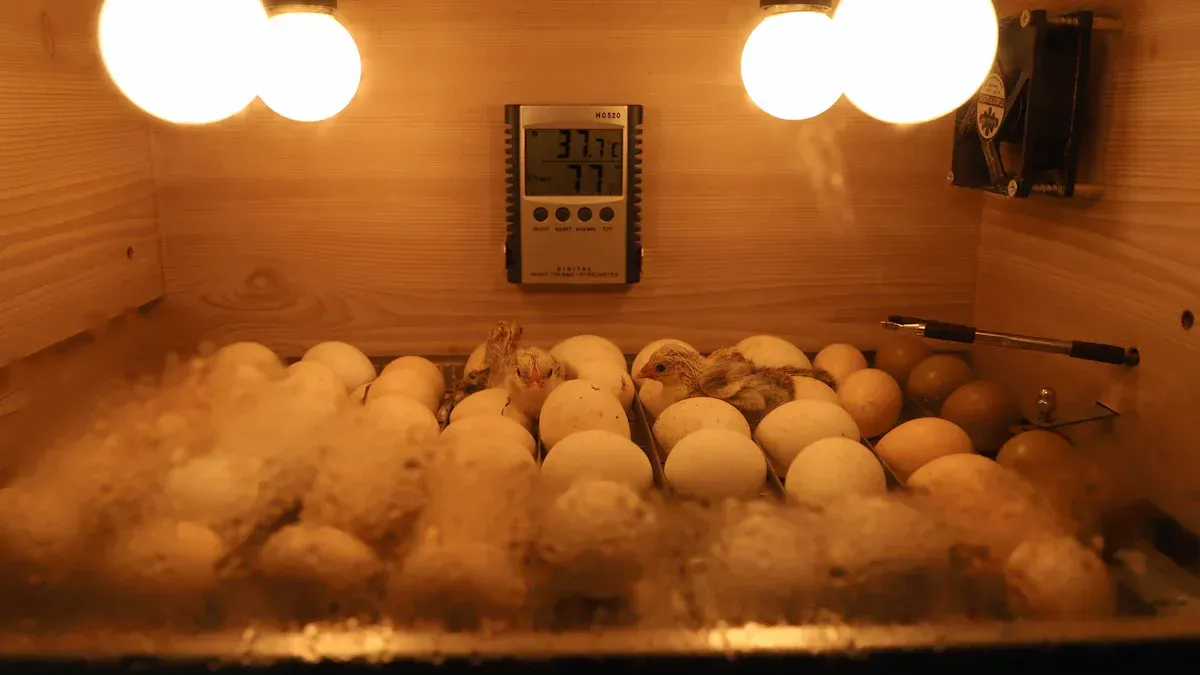
Now let’s talk about what you can actually put on your table. There is no one “perfect” incubator for everyone. The best choice depends on how many eggs you want to set, how often you plan to hatch, and how hands-on you want to be.
Below are a few simple starting points for 2025. The names can change as we add new models, but the roles stay the same. Think of these as seats at the table: a small starter machine, a value workhorse, a mid-size option, and a classroom-friendly pick.
Automatic 3-tray incubator for small mixed flocks
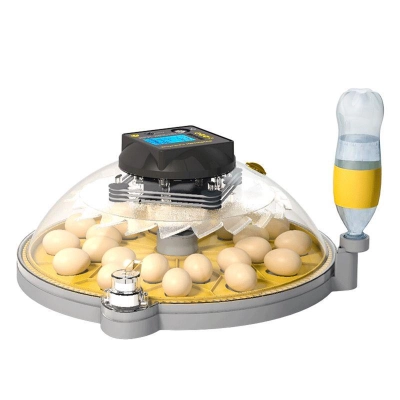
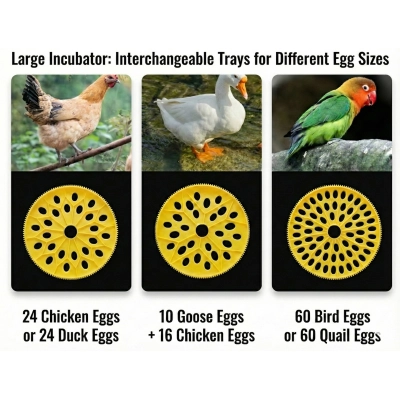
If you keep a small flock and like the idea of hatching chicken eggs plus quail or small bird eggs, an automatic three-tray incubator is a strong choice. Our Automatic Egg Incubator 3 Trays for Birds and Quail is built for this kind of mixed clutch. It has shallow trays that spread heat and air across the eggs and a built-in automatic turner so you do not need to tilt trays by hand all day.
This type of incubator works well if you want a “set it and watch closely” experience rather than a “set it and forget it” promise. You still need to check temperature and humidity, but the machine does the turning and air mixing for you.
Compact starter incubator for 6–12 backyard eggs
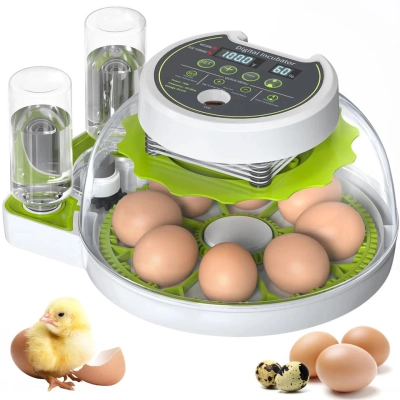
If you only want to hatch a handful of chicks for a backyard flock, a small forced-air incubator that holds about 6–12 chicken eggs is often enough. This size is easier to fit on a kitchen counter or shelf and uses less power than a large cabinet.
Look for a clear lid that lets you and your kids watch the action, an automatic turner, and a simple control panel. Many families like to pair a compact incubator with our deeper guide Best Chicken Egg Incubator for Beginners, which walks through more model examples and setup tips.
Mid-size incubator for growing flocks and small farms
If you plan to hatch for yourself and for friends or customers, a mid-size incubator that holds 20–30 chicken eggs can make more sense. This size lets you run fewer batches per year while still keeping your brooder full when you need replacement layers or meat birds.
Key things to watch for in this range are a strong fan, good insulation, and easy cleaning between runs. You can use our guide to comparing chicken egg incubators to think through which mid-size features matter most for your home or farm.
Classroom-friendly incubator for teaching hatches
For a classroom hatch, you want more than a low price. You need a machine that is safe, stable, and interesting for students to watch. A classroom-friendly incubator should have a large clear window, a simple control panel, and a design that does not invite kids to open the lid during lockdown.
Many teachers also like models with built-in candling lights and clear humidity channels so they can turn each step into a lesson. If you are planning a school hatch, it helps to choose your incubator early in the school year. That gives you time to test it before you invite a room full of kids to watch the 21-day process.
What features to look for before you buy
When you stand in front of a shelf of incubators, it is easy to feel lost in the list of features. Let’s keep it simple. Here are the main things to look for before you buy a chicken egg incubator.
Automatic vs. manual egg turning
An automatic turner tilts or rolls the eggs for you several times each day. A manual incubator expects you to open the lid and turn the eggs by hand. Manual turning can work if you are home and can stick to a schedule. But if your days are busy or you tend to forget, an automatic turner is often worth the extra cost.
Clear temperature and humidity display
You should be able to read the temperature and humidity without squinting. The numbers should not jump wildly every second. A simple digital screen that shows both values in real time is enough for most homes and classrooms.
Many hatchers also like to set up a backup thermometer and hygrometer inside the incubator. You can learn how to think about these tools and their costs in our egg incubator buying guide for backyard chicken keepers in 2025.
Airflow and ventilation
Forced-air incubators use a fan to mix warm air. Still-air models do not. For most beginners, a small forced-air incubator is easier because it keeps the temperature more even inside the box. You should also check that the incubator has clear vents and that the manual explains how to adjust them during hatch.
Cleaning and maintenance
Every hatch leaves behind fluff, dust, and a bit of mess. A good incubator has smooth surfaces, removable trays, and enough space for your hand to reach all corners. You will clean it between hatches, and that cleaning is part of your hatch success over the long run.
Capacity that fits your plan
For many hobbyists, a 6–12 egg incubator is enough for a small backyard flock. If you plan to hatch often or raise extra chicks for sale, a 20–30 egg model gives you more room to grow without jumping up to a large cabinet.
Think about how many chicks you really want at one time, and remember that not every egg will hatch. It is better to choose a size that fits your brooder and your feed budget than to max out a giant incubator just because it is on sale.
Where to find reliable chicken egg incubators for sale online
Once you know what you want, the next question is simple: where do you actually buy a chicken egg incubator that you can trust? You have a few main paths.
EggBloom chicken egg incubator collection
If you want incubators chosen with backyard and small farm use in mind, start with the EggBloom Chicken Egg Incubator collection. Our focus is on poultry hatching, not on random gadgets, so the models there are picked with flock size, ease of use, and long-term support in mind.
On the collection page you can filter by capacity and see which models have automatic turning, forced-air design, or special trays for quail and other small birds. It is a good “tool shed” to browse when you are still deciding which role you need your incubator to fill.
Large online marketplaces
Big marketplaces carry many incubators at many price points. You can sometimes find very low prices there, but quality can vary a lot from one listing to the next. When you use a marketplace, it helps to read reviews over time, not just from one sale week. Look for patterns about temperature stability, build quality, and customer support.
Local farm and feed stores
Some people like to buy from a local farm store so they can see the incubator in person before they pay. The staff may know which models local customers like and which ones tend to come back. The trade-off is that local stock is often seasonal and the range of models is smaller than what you see online.
Best time to buy and how to catch real deals
The right incubator is one thing. The right timing is another. Buying at the right time can give you better stock choices and fair prices without chasing the lowest number on the page.
Buy before your hatch season, not at the last minute
If you want chicks on the ground in spring, do not wait until the week you plan to set eggs to order your incubator. Shipping delays, stock shortages, or a small fault out of the box can all cost you days.
A simple rule is this: if you want chicks in April, try to have your incubator at home and tested by February or early March. Run it empty for a day or two. Check that it can hold about 99.5°F in a forced-air setup and that you can reach your target humidity. That calm dry run often saves you a lot of stress later.
Seasonal sales and discount periods
Many stores run sales around major holidays and at the end of the year. You may also see discounts at the end of the main hatching season when stores clear space for other stock. Those times can be good for your budget, but they are not the only time to get value.
When you see a discount, look at more than the new price. Check which models are on sale, how long the warranty lasts, and whether you can get parts later. A deep discount on a model that is hard to support is not a real bargain for someone who wants to hatch year after year.
How to spot a real deal vs. a risky bargain
A real deal is a solid incubator at a fair price with clear support. A risky bargain is a machine that looks cheap at checkout but costs you in lost hatches, extra worry, or early failure.
Before you click “buy,” ask yourself a few questions. Does this incubator have steady reviews over time, not just in the last sale week? Is there a clear manual? Can you reach the seller if something fails? Does the build look strong enough to clean and use for several years? If the answer is “no” to most of these, even a low price may not be worth it.
Accessories and replacement parts — what you really need
A bare incubator can hatch chicks, but a few simple tools and spare parts make your life easier and your results more steady. You do not need to buy every gadget you see. Focus on the pieces that help you see what is going on and keep the incubator in good shape.
Backup thermometer and hygrometer
Even good built-in sensors can drift over time. A small digital thermometer and hygrometer set gives you a second opinion inside the incubator. Place them at egg height. If the readings differ from your main screen, you can adjust your target to match real conditions.
Egg candler
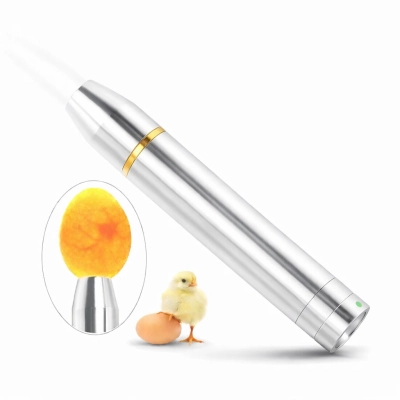
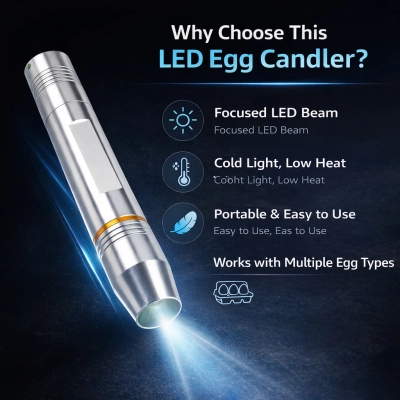
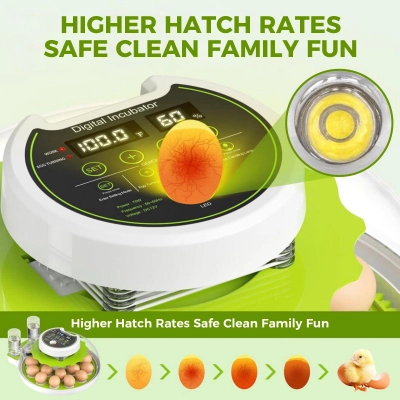
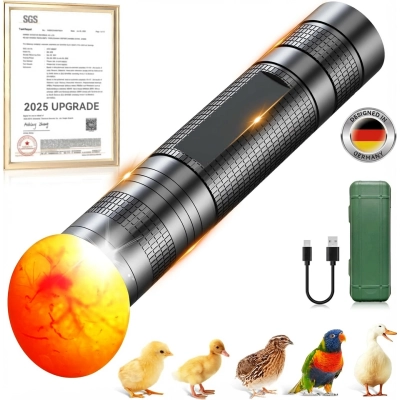
An egg candler is a small, bright light you hold against the blunt end of the egg in a dark room. When things go well, you will see thin red lines like a spider web by the end of the first week. Those lines are blood vessels and they tell you the embryo is alive and growing.
Later, you will see the dark shape of the chick fill more of the egg and the air cell grow at the top. Candling is one of the best ways to learn what is happening inside without opening the eggs or the chicks’ shells.
Extra water trays, sponges, and cleaning tools
Extra water trays or small pieces of clean sponge can help you adjust humidity without soaking the whole incubator. You can add or remove surface area to push the humidity up or down a little at a time.
After each hatch, you will need to wash and dry the incubator. Soft brushes, cloths, and a safe disinfectant that does not leave a harsh smell will help you reach every corner and keep germs from building up from batch to batch.
Replacement parts
Fans, turning motors, and trays work hard over many hatches. It is worth knowing up front whether you can buy replacements if something wears out. For the models we stock, we keep an eye on parts support and update product pages when replacement pieces are available.
FAQ — buying a chicken egg incubator in 2025
Where can I find reliable chicken egg incubators for sale online?
You can find reliable incubators in a few places. The EggBloom Chicken Egg Incubator collection is a good starting point if you want models chosen for backyard flocks, small farms, and classrooms. Large marketplaces and local farm stores can also work if you take time to read reviews, check warranty details, and look for signs of steady performance over several seasons.
What are the best chicken egg incubators for sale for beginners?
The best incubators for beginners are simple, steady, and not too large. A small forced-air incubator with an automatic turner, clear lid, and an easy display is often a good first choice. Our beginner incubator guide walks through more examples and explains what makes a model beginner-friendly in plain language.
What features should I look for in a chicken egg incubator?
Look for automatic turning, a clear temperature and humidity display, a fan for even airflow, and a design that is easy to clean. Make sure the capacity fits your plan and that you can understand the manual without a degree in engineering. If a feature sounds fancy but you cannot explain how it helps the chicks, you probably do not need it for your first few hatches.
What capacity incubators are recommended for hobbyists?
Many hobbyists do well with a 6–12 egg incubator for a small backyard flock. If you want to hatch for friends, neighbors, or a small farm stand, a 20–30 egg incubator gives you more room while still fitting in a normal home. Think about how many chicks you can brood and care for at one time, then choose a size that matches that real number instead of the biggest box on the shelf.
Where are the best deals on chicken egg incubators?
The best deals are usually steady, well-built incubators at fair prices with clear support, not the cheapest listing on the page. You can find good value in curated collections like EggBloom’s, during seasonal sales, or at local stores clearing stock. No matter where you shop, check real user feedback, warranty terms, and whether parts are available before you decide that a price is truly a “deal.”
When is the best time to buy a chicken egg incubator?
The best time to buy is a few weeks before you plan to start your hatch, not the night before you want to set eggs. Buying in late winter or early spring works well for most chicken hatches because you can test the incubator before your main batch. Holiday sales and end-of-season discounts can also be helpful if you are shopping ahead for the next year.
Where can I buy incubator accessories and replacement parts?
You can find accessories and parts in the same places you find incubators. Many people buy backup thermometers, hygrometers, candlers, and cleaning supplies from the same store where they bought the incubator. For the models we carry, we note on the product page when common replacement parts are available so you can keep a good machine running for many seasons instead of replacing it after one fault.
0 Comments