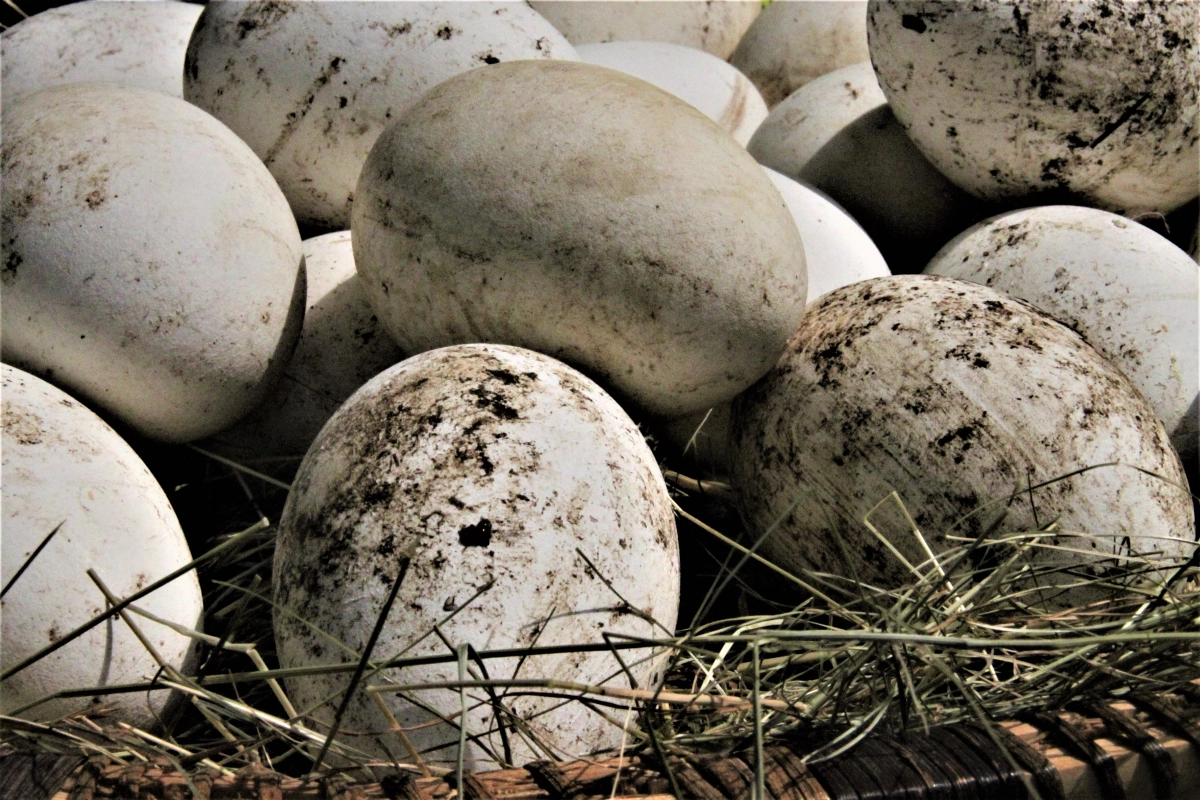
Most domestic goose incubation runs 28–35 days depending on breed and weather. Watch three things: the broody goose’s routine, candling milestones, and air-cell growth / weight-loss (aim roughly 12–14% by lockdown). Check quickly at key points, keep the nest safe and dry, and avoid over-handling.
Goose Incubation Length by Breed
Use these as practical ranges—individuals vary with temperature, egg size, and humidity:
~28–31 days
- Chinese
- Roman
- Pilgrim
~30–33 days
- Embden
- Toulouse
- Buff / American
~31–35 days
- African
- Saddleback Pomeranian
- Large & heavy strains
Rule of thumb: If you don’t know the exact breed, plan for ~30–32 days, then adjust by what you see (air-cell line, embryo activity, internal pip).
Broody Goose Behavior: What You’ll See
- Pulls breast down to line the nest; sits tight and becomes more defensive.
- Leaves the nest 1–2 short breaks/day to eat, drink, bathe, and defecate; often returns with slightly damp belly feathers that add nest moisture.
- Turns eggs with her beak when returning; soft grunts/hiss when you’re near.
- Close to hatch you may hear faint peeps and see a higher, lighter sit as eggs internally pip.
Tip: Place a shallow pan of fresh water near—but not inside—the nest, so she can hydrate and manage humidity without soaking eggs.
Nest Setup & Egg Management
- Dry, shaded, draft-free site with easy access to clean water and feed; block predators.
- Use clean straw/shavings (not dusty) with a slight bowl shape; refresh if soaked.
- Mark eggs lightly with pencil on the blunt end to spot late intruders and remove them.
- When handling is unavoidable: clean hands, minimal time, return eggs in the same orientation.
Day-by-Day Signs & Candling (28–35 days)
Milestones by Percent of Total
- 0–10% (≈ Day 0–3 @30 days): clear egg, small air cell; no judgment.
- 15–25% (Day 5–8): first vessel network and embryo spot — do a quick candling.
- 35–50% (Day 11–15): larger dark area and movement; second quick check.
- 65–75% (Day 20–23): slanted air-cell line appears; reduce disturbance.
- 80–95% (Day 24–29): faint ticking/inner movement in the air cell; only very short confirmation.
- Final Phase: external pip → push/zip → hatch. 24–48 h spread is normal.
30-Day Example
- Day 0–3 — clear; no call.
- Day 6–8 — vessels & embryo spot (first check ≤ 60–90 s).
- Day 12–15 — stronger movement; air-cell ~5–7% (second check).
- Day 20–23 — slanted air-cell; minimize handling.
- Day 26–28 — internal pip / faint peeps; only brief confirmation.
- Day 28–31 — external pip → hatch (later if cooler, larger eggs, or slower weight-loss).
Need pictures of each stage? See our day-by-day candling photo examples and common red flags.
Air-Cell Growth & Weight-Loss (your humidity dashboard)
- Aim for 12–14% total weight-loss by hatch for large waterfowl eggs (use as a working range).
- Every 3–4 days: weigh, and pencil the air-cell edge on the blunt end (take a same-angle photo for comparison).
- If air cell is too small / loss is slow → too humid / poor ventilation: increase airflow or reduce water exposure in/around the nest.
- If air cell is too large / loss is fast → too dry: reduce drafts, add clean absorbent bedding, and ensure the goose has water to bring in on feathers.
Working in thin mountain air? Review high-altitude incubation adjustments.
Humidity, Ventilation & Temperature (natural hatch support)
Your goal isn’t a fixed RH number—it’s a correct weight-loss curve. In dry heated seasons, block drafts and deepen the nest cup. In rainy seasons, keep bedding dry and improve ventilation without chilling the goose. Overheating is riskier than brief cool periods; provide shade and airflow, and avoid heat-soaked metal or concrete bases.
Red Flags & What to Do
- Blood ring / weepy or foul eggs → mark, remove, and dispose safely.
- Detached air cell (common in shipped eggs) → store upright 24–48 h; minimize vibration and turning.
- No progress after internal pip for 24–36 h or obvious malposition → re-check temperature, humidity, and ventilation. If true distress is confirmed, any help should start from the air cell, in tiny steps, with frequent returns to the nest/incubator.
- Storms or prolonged power loss → keep warm and limit opening; follow an outage plan (see our SOP).
Climate & Season Notes
Dry heat / high altitude: evaporation runs faster—watch for oversized air cells and adjust for moisture/ventilation. Rainy or coastal humidity: evaporation runs slow—keep bedding dry, reduce fresh water exposure around the nest, and remove late intruder eggs that would shift the whole clutch later.
What You Should Log
- Date, egg ID (pencil mark), weight, and cumulative % loss
- Air-cell line (photo from the same angle works great)
- What you saw during candling and what you changed (change one variable at a time)
FAQ
How long can a broody goose leave the nest?
Short 15–30 minute breaks for food, water, and bathing are common. On hot afternoons, overly long breaks may overheat the clutch; ensure shade and safety.
Do I need to candle every day?
No. Use key checkpoints (about Day 7 / Day 14 / Day 26–28 depending on breed length). Keep each check to 60–90 seconds.
What counts as a “late hatch”?
24–48 hours beyond the breed’s expected window is usually within normal spread, especially with cooler temps, larger eggs, or slower weight loss. Confirm with your air-cell line and scale record before intervening.
Should I mist or add water to the eggs?
For natural hatches, avoid spraying the eggs directly. Support humidity indirectly—let the goose bathe and return with damp belly feathers while keeping bedding dry and draft-free.
Printable Timeline Table
| Checkpoint | 28-day types | 30-day types | 35-day types | What you’ll see | Your action |
|---|---|---|---|---|---|
| First check | D6–7 | D6–8 | D7–9 | Vessel network + embryo spot | Record & outline air cell; ≤ 90 s |
| Second check | D12–13 | D12–15 | D14–17 | Stronger movement; air-cell ~5–8% | Verify weight-loss curve |
| Third check | D24–25 | D26–28 | D30–32 | Internal pip / faint peeps; slanted air-cell | Very short confirmation only |
| Hatch window | D26–29 | D28–31 | D33–36 | External pip → hatch | Quiet, shade, and do not over-open |
This table is a guide. Prioritize your air-cell/weight-loss records and real signs from the eggs.


0 Comments