Key Takeaways
Artificially incubating pigeon eggs is powerful, but it’s not very forgiving. Small swings in temperature, humidity, and handling can turn a promising clutch into a tray of clears or late dead chicks, even when you feel like you “did everything right.”
The goal of this guide is not to give you one magic setting, but to help you recognize the most common pigeon egg incubation problems, understand what they mean, and know where to adjust next. Think of it as a troubleshooting map: you spot the pattern you’re seeing in your own incubator, then follow the path toward likely causes and practical fixes.
Key points you’ll see come up again and again:
-
Pigeon eggs are more sensitive than chicken eggs. The same mistakes that chicken eggs sometimes tolerate will show up quickly in pigeons.
-
Temperature, humidity, and turning work together. Problems at hatch usually reflect a long chain of conditions, not just one bad day.
-
Your room and equipment matter as much as your settings. Drafts, power cuts, and inaccurate sensors quietly sabotage many small incubators.
-
Fertility and egg quality still count. Some “incubation failures” are really breeder or egg problems, not machine problems.
-
Notes turn frustration into progress. Simple records from each batch help you see patterns and improve instead of guessing.
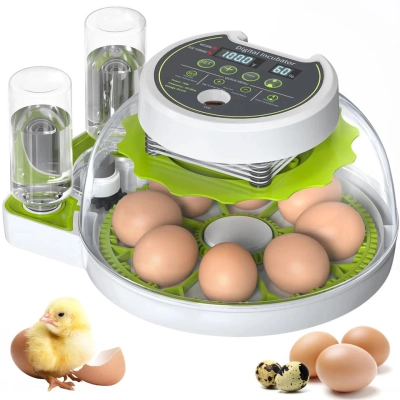
If your current gear makes it hard to keep things steady, it can help to explore dedicated pigeon egg incubators designed for small backyard lofts so your equipment works with you instead of against you.
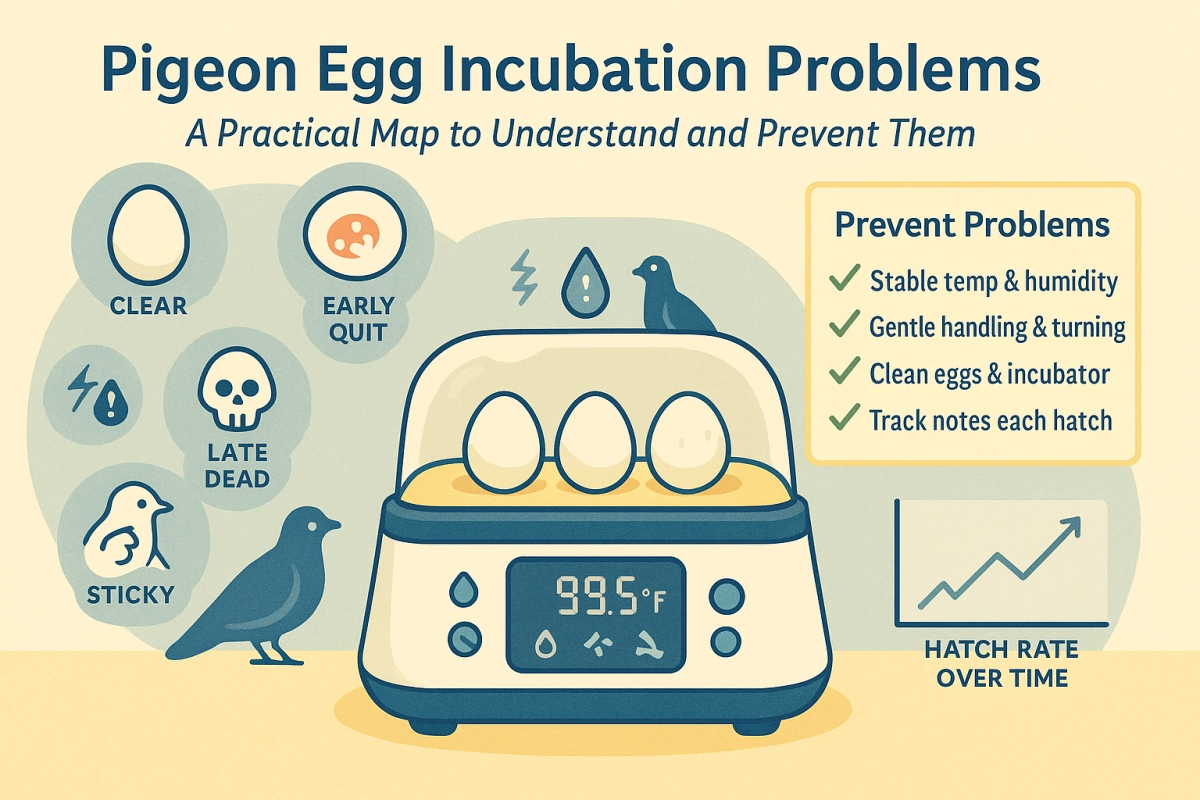
Quick problem map for pigeon egg incubation problems
Common symptoms and what they mean
When a hatch goes badly, it helps to name the pattern instead of just thinking “they all failed.” Most pigeon egg incubation problems fall into a few clear symptom groups.
-
Eggs stay completely clear at candling.
-
Likely causes: low fertility, poor breeder condition, very rough handling or storage before incubation.
-
-
Blood rings or tiny embryos that quit early.
-
Likely causes: temperature spikes or drops, bacterial contamination, or severe jolts in the first week.
-
-
Well-developed chicks dead in the shell.
-
Likely causes: temperature slightly off for most of incubation, poor moisture loss, or turning issues.
-
-
Pipped but not hatching, or chicks stuck and sticky.
-
Likely causes: humidity issues (too high or too low), weak chicks, or mistakes near lockdown.
-
-
Rotten, smelly, or oozing eggs.
-
Likely causes: bacterial contamination, dirty shells, or poor incubator hygiene.
-
Seeing which group dominates in a batch tells you where to start: breeders and egg handling, machine settings, room environment, or hygiene.
How to use this map for troubleshooting
Treat each batch as a mini case study. After candling and after hatch, quickly note how many eggs fall into each symptom group: clear, early quit, late dead, sticky, rotten. Over a few rounds, those notes will show you patterns much more clearly than memory ever can.
If most of your failures are clear eggs, for example, it makes more sense to adjust breeder nutrition, pairing, and timing than to keep chasing incubator numbers. If you see many blood rings after a known power outage or big room temperature swing, that’s a strong signal to focus on stability. And if the same kind of late deaths keep appearing even when power and room temperature are steady, it’s time to look harder at humidity and turning.
This map doesn’t replace your judgment, but it keeps you from trying to fix everything at once. You’re not alone in these patterns—backyard lofts and classroom projects all over the world run into the same clusters of issues, and most can be improved with a few focused changes.
Why pigeon eggs are less forgiving than chicken eggs
Key differences in shell, size, and sensitivity
Pigeon eggs are smaller than chicken eggs and have less thermal mass, which means they gain and lose heat faster. A short draft, a quick power dip, or a long candling session that barely nudges chicken eggs can be enough to stress pigeon embryos, especially in the first week. The same is true for moisture: smaller eggs lose water more quickly and respond faster to changes in humidity.
Because of this, pigeon eggs tend to reveal small errors you may never have noticed with chickens. Slightly uneven heating across the tray, a miscalibrated thermostat, or vent positions that are “close enough” for chicken eggs can lead to clear patterns of early death or weak hatches in pigeons. Recognizing that sensitivity doesn’t mean you should be afraid to incubate pigeon eggs—it just means you aim for a narrower comfort zone and pay more attention to how your particular setup behaves.
Mistakes that matter more with pigeon eggs
Some habits from chicken egg incubation quietly become “pigeon problems.” Leaving the incubator in a room with big day–night swings, opening the lid many times a day, or trusting a built-in thermometer without ever checking it may not ruin a tray of chicken eggs, but pigeon eggs will often show the cost. Late hatches, dead-in-shell chicks, and sticky squabs are common outcomes when those habits carry over unchanged.
A useful mindset is to assume that pigeon eggs are less tolerant, not more. That means shorter, more purposeful openings; verifying temperature and humidity with independent instruments; and being more deliberate about where you place the incubator and how you handle eggs. No guide or incubator can promise 100% hatch rates—especially not with pigeons—but reducing the number of “avoidable mistakes that count extra” is where many keepers see their biggest improvements.
Temperature stability challenges in small incubators
What stable temperature means for pigeon eggs
For pigeon eggs, a “stable” temperature is more than just a number on the screen. It means the air at egg height, across the whole tray, stays very close to target day and night with no big peaks or dips. In small tabletop incubators, heating elements cycle on and off quickly and the egg tray is close to the lid, so small room changes or frequent openings translate into noticeable swings around the embryos.
Instead of trusting the display completely, place a separate, accurate thermometer at egg level and log what it reads a few times a day for at least one full incubation. Many keepers discover that the real temperature runs half a degree hotter or cooler than the setpoint, or that the center of the tray is consistently warmer than the edges. If your pigeon chicks are always hatching a day early and coming out a bit small and weak, that suggests the average temperature has been slightly high; if they’re consistently late or many fully formed chicks never pip at all, you may be running a bit low.
Typical temperature errors and fixes
A very common error is putting the incubator somewhere convenient instead of somewhere stable. Placing it near a window, heater, or air-conditioning vent means the machine is constantly correcting for drafts, sun, and cycling equipment. Moving the unit to a small interior room where the daily temperature range is narrow often has more impact than any fine-tuning of the thermostat itself.
Another quiet troublemaker is uneven heating inside the incubator. If eggs in certain corners repeatedly fail while others in the middle do well, gently rotate positions between batches and pay attention to the pattern. Over time, you can avoid known “cold spots” for the most valuable eggs.
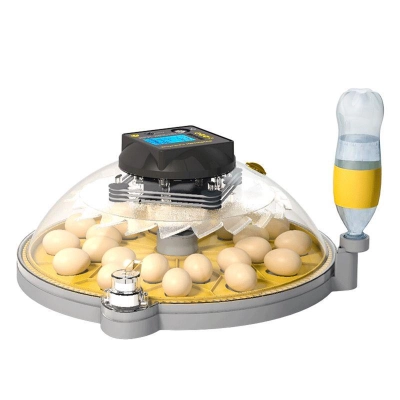
Once you understand how your current machine behaves, you might decide it’s worth upgrading to something more precise. An automatic egg incubator with three trays designed for small bird eggs can make it much easier to hold a narrow temperature band, especially when combined with your own habit of cross-checking with a separate thermometer and keeping simple logs.
Humidity control and difficulties with eggs
Signs of incorrect humidity in pigeon eggs
Humidity problems usually show up at the end of incubation, but they start much earlier. If humidity is consistently too high, pigeon eggs won’t lose enough moisture, the air cell stays small, and chicks often end up big, wet, and struggling to breathe. You may see sticky chicks glued to the shell and yolk that isn’t fully absorbed. If humidity is too low, the air cell grows too fast, membranes dry out, and chicks end up thin, weak, and shrink-wrapped.
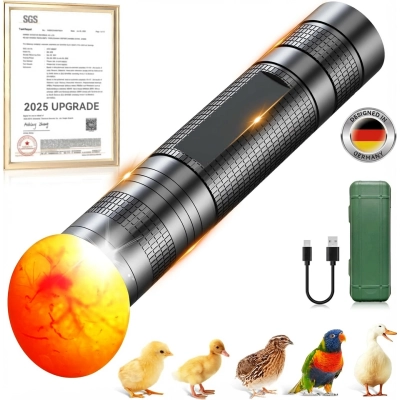
Candling at mid-incubation gives you a chance to spot this early. Compare the air cell size in your eggs to simple reference sketches for that day. If the cells are clearly smaller, humidity has likely been too high; if they’re larger, too much moisture has been lost. On hatch day, look closely at the condition of any unhatched or assisted chicks. Overly wet, jelly-like chicks point toward excess humidity, while dry, tight membranes and oversized air cells point toward air that was too dry for too long.
Adjusting humidity for small incubators
You don’t need complex equipment to adjust humidity in a small incubator—just a bit of patience and a plan. Most tabletop units rely on exposed water channels in the base, so your first lever is water surface area. To raise humidity, fill more channels or add a clean sponge that increases water surface area; to lower it, reduce the number of channels you fill or cover part of the tray so less water is exposed. Make a change, wait a few hours for things to settle, and then read your hygrometer again before deciding whether to adjust further.
Ventilation is your second control. Closing vents slightly tends to increase humidity by trapping moisture, while opening them allows more dry room air to enter. Small changes–a quarter turn or one notch at a time–are usually enough. Because pigeon eggs react quickly, it’s better to make gradual adjustments over several days than to swing humidity wildly back and forth in a single afternoon. Over several batches, note which combination of water channels and vent positions gives you healthy air cells and clean hatches in your specific climate.
Handling and turning pigeon eggs safely
Turning frequency and technique
Turning keeps the growing embryo from sticking to the shell membranes and helps the blood vessels spread evenly, but you don’t have to chase perfection to get good results. For pigeon eggs, turning at least three times per day during the main growth period works well for most small-scale keepers. The eggs should tip from one side, past level, to the other side—not just wiggle in place. Automatic turners handle the motion for you, while manual turning relies more on your routine.
You’ll want to stop turning a little before hatch so the chick can settle, usually about two to three days before the expected hatch date for pigeons. Stopping too early can increase the risk of early sticking; stopping too late can leave chicks poorly positioned to pip and zip. Pick a lockdown time, stick to it for a few batches, and only adjust by half a day earlier or later if you see consistent positioning issues.
Common handling mistakes and solutions
With small eggs, rough handling and constant opening of the incubator can cause more harm than people realize. In classrooms and busy homes, it’s common for many different hands to handle the eggs at random times “just to check.” Each extra opening drops temperature and humidity, and each careless turn adds the risk of cracks or detached air cells.
A simple fix is to assign one or two “turning managers,” mark each egg with an X on one side and an O on the other, and turn them at set times each day. That keeps the project hands-on while making the handling predictable and gentle. If you’re using a chicken-sized egg rack, adding foam, paper egg trays, or small rings under pigeon eggs can prevent them from rattling or rolling violently when the automatic turner moves.
If you prefer to see a full day-by-day flow wrapped around these turning principles, you can pair this article with a more detailed step-by-step pigeon egg hatching guide so you always know what comes next.
Fertility, egg quality, and breeder management
What clear eggs and blood rings reveal
Not every failed egg is an incubator problem. Some were never fertile, and others carried weaknesses from the parent birds that no machine could fix. Clear eggs that remain completely transparent at day 7–10 were almost certainly infertile or contained embryos that died very early. A high percentage of clears in several batches points toward breeder or mating issues rather than temperature or humidity.
Blood rings—where you see a ring of blood around the yolk instead of a growing embryo—suggest that development began and then stopped in the first days of incubation. That can be caused by sharp temperature swings, rough handling, or contamination entering through tiny cracks or pores in the shell. Learning to read these signs makes your troubleshooting much more precise: you don’t blame breeders for issues that are actually incubator-related, and you don’t waste weeks tweaking settings when the eggs themselves were never viable.
If you’d like visual examples to compare against what you see at home, it’s worth walking through a focused guide on how to tell if a pigeon egg is fertile when you candle and using that alongside your own notes.
When to check breeders vs. incubator
When most eggs in a batch are clear, or fertility drops suddenly compared to previous clutches, it’s time to look closely at your breeders. Age, diet, stress, and health all affect fertility and egg quality. Older birds, overweight or underweight pigeons, and pairs under constant disturbance often produce more infertile or weak eggs, even if your incubation technique is sound.
Start with basics: a balanced breeding diet, constant access to clean water, and a calm, secure loft. Check that pairs are actually mating and that you’re not depending on birds that are too young or nearing the end of their productive years. If you see other warning signs—poor feather condition, weight loss, unusual droppings—it’s wise to consult an avian vet or experienced breeder. No article can replace a proper health assessment when something seems off.
If, on the other hand, fertility looks good but embryos are dying at the same stage across multiple batches, then your incubator settings, room environment, or handling habits are more likely to be at fault. Separating “breeder issues” from “incubation issues” stops you from chasing the wrong problem.
Room environment and power issues
How drafts and power cuts affect incubation
Even a good incubator struggles if the room around it is unstable. Drafts from windows, doors, radiators, or air conditioners constantly push warm or cool air across the machine. In a small incubator, that means more frequent heating and cooling cycles, and pigeon eggs feel those changes much faster than larger eggs. Over time, repeated swings add stress that shows up as early deaths, weak chicks, or uneven hatches.
Power interruptions add another layer of risk. A brief outage in the middle of incubation might be recoverable if the incubator stays closed and the room is warm, but longer or repeated cuts can cool the eggs too much or throw off development timing. After any significant outage, make a note of when and how long it lasted, then see if that batch shows unusual problems when you candle and at hatch. That way you can tell whether this was a one-off event or part of a larger pattern of instability.
Choosing the best spot for your incubator
The “best” place for an incubator is usually not the most convenient. For most small-scale keepers, a small interior room away from direct sun and strong airflow works far better than garages, sheds, or porches where temperature can swing dramatically between day and night. Many pigeon keepers report a noticeable drop in late deaths and weak chicks just from moving a tabletop incubator from a drafty outbuilding into a quiet room inside the house.
Look for a location where you don’t need to walk past or open doors constantly, where the room temperature stays relatively steady, and where the incubator can sit on a sturdy, level surface. Mark the spot as “off limits” for curious pets and children. A stable, boring environment for the incubator often leads to a much more predictable hatch, especially with sensitive pigeon eggs.
Using chicken egg incubators for pigeon eggs
Common difficulties with eggs in chicken incubators
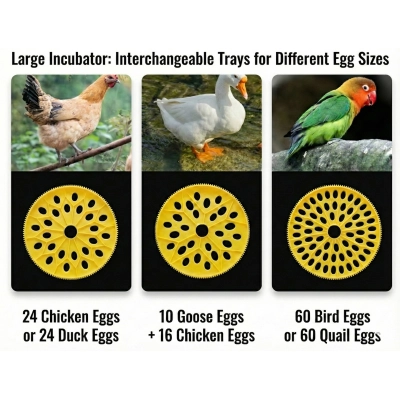
Most small-scale pigeon breeders start with what they already have: a chicken egg incubator. This is completely understandable, but those machines are usually designed around larger eggs, and that creates some specific challenges. Pigeon eggs may sit loosely in big egg cups, roll too much when the turner moves, or rest too close to heating elements intended for larger thermal masses. Water channels sized for chicken clutches can also drive humidity higher than ideal if you fill them fully for small pigeon eggs.
Those design assumptions mean you can’t simply copy your chicken-egg routine and expect the same results. You may see more eggs with detached air cells from rolling, more uneven hatches from hot and cool spots, or more sticky chicks from overgenerous humidity. Recognizing these as design mismatches rather than personal failures can be a relief—and it points you toward practical modifications instead of endless frustration.
Modifications and workarounds
You can often make a chicken egg incubator friendlier to pigeon eggs with simple additions. Foam inserts, paper egg trays, or small cups placed in the existing racks cradle pigeon eggs so they tilt smoothly instead of rattling. Filling only part of the water channels, or placing water in a smaller dish inside the tray, gives you finer control over humidity.
It also helps to map your incubator’s “personality.” Note which positions consistently hatch best, how quickly the machine recovers from openings, and how your separate thermometer readings compare to the display. Over several batches, you’ll learn where to place your most valuable eggs and what room conditions help this particular unit perform its best. If you eventually decide to move to an incubator designed from the start for small bird eggs, the habits you’ve built—measuring, observing, and adjusting gradually—will carry over and pay dividends immediately.
Troubleshooting late deaths and sticky chicks
Recognizing dead-in-shell and sticky chick symptoms
Late deaths and sticky chicks are some of the most discouraging outcomes, because the eggs look promising right up until hatch day. Dead-in-shell chicks are usually fully formed and often found in the correct position, but they never pip or only make a tiny external pip before stopping. Sticky chicks are covered in thick, gluey fluids and membranes that cling tightly to their skin and feathers, making it hard for them to move or breathe.
Both patterns usually reflect long-term issues across incubation rather than a single bad moment. Late deaths often point to temperature that has run slightly high or low for most of the cycle, or to turning problems that left the chick poorly positioned. Sticky chicks and shrink-wrapped chicks usually result from humidity that was too high or too low overall, especially in the final days. When many eggs in the same batch show similar problems, that’s a strong clue that your settings, room conditions, or handling need adjustment more than anything else.
Step-by-step fixes for these problems
Start by separating out what you can control. For late deaths, review your temperature logs and hatch timing. If most chicks are consistently early or late, adjust your average temperature slightly for the next batch. Check whether eggs in certain areas of the tray fail more often and rotate positions accordingly. For sticky or shrink-wrapped chicks, compare air cell size at lockdown, revisit your water routine, and make measured changes to humidity in the next round rather than swinging from one extreme to the other.
You’ll also want a clear philosophy on assisted hatching. Some keepers choose to help chicks that are clearly stuck, while others prefer to let nature take its course. Whatever you decide, it’s important to do it safely and only when needed. If you’d like guidance on when and how to intervene, it’s worth reading a dedicated resource on pigeon assisted hatching and safely helping a stuck squab. Remember that even with good judgment and careful technique, not every late or sticky chick can be saved, and forcing things too early can cause more harm than good.
Systematic review after multiple failures
Keeping records and learning from each hatch
When you’ve had a few disappointing hatches in a row, it’s normal to feel tempted to give up or change everything at once. A more effective approach is to become a calm, curious investigator of your own process. Simple notes about each batch—the date, parent pair, number of eggs, basic settings, room details, candling observations, and hatch results—turn vague frustration into data you can actually use.
After just a handful of clutches, you’ll start to see patterns: certain pairs with consistently poor fertility, certain incubator positions that run hot or cool, certain humidity routines that produce better air cells. That makes your next decisions much clearer: change one or two things based on the most obvious pattern, run another batch, and see what happens. You’re building a picture of what works in your specific loft, climate, and equipment, not chasing someone else’s perfect numbers.
When to upgrade your setup
There comes a point where honest notes show that you’ve done the basics well—healthy breeders, clean eggs, careful handling, reasonable settings—and yet the same pigeon egg incubation problems keep showing up. That’s when it’s worth asking whether your current incubator, room, or power situation is holding you back. Moving the machine to a more stable room, adding a small backup power solution, or upgrading to a model with better control and airflow can all make a real difference.
It’s important to hold your expectations realistically, though. Even in well-managed lofts with good equipment, not every pigeon egg will hatch. The real success is when your overall hatch rate improves over time, your failures make more sense, and you feel more in control of the process instead of at the mercy of random luck. With that mindset, each batch—good or bad—becomes another step toward the steady, reliable pigeon hatches you’re working for.



0 Comments