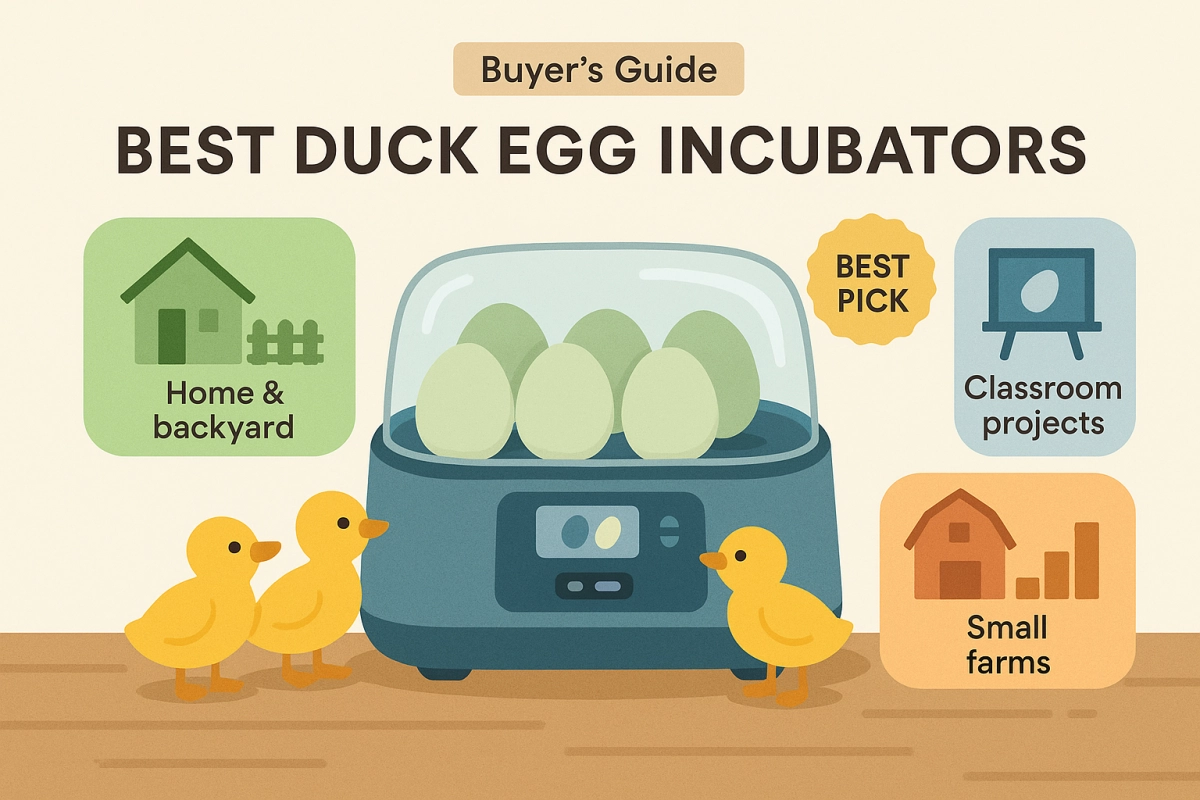
When you look for a duck egg incubator, you usually do not want a long lecture. You want to know which type of machine will work in your house, in your classroom, or on your small farm. Maybe you have a few ducks in the backyard and a small laundry room. Maybe you run a homestead and collect trays of eggs at a time. Or maybe you are a teacher who must keep the room clean, quiet, and safe. This guide keeps these real scenes in mind and helps you choose with a clear and calm head.
This article explains what duck eggs need for about 28 days in an incubator, how different incubator styles fit home, classroom, and small farm use, and how you can match your budget to your goals. It also sets honest expectations about hatch rates, because even a good incubator and careful work will not give you a 100% hatch every time.
Quick picks: best duck egg incubators by use case (2025)
If you want a fast overview before you read details, this section is for you. Think about which scene looks most like your own, then see how duck egg incubators usually line up with that use in 2025.
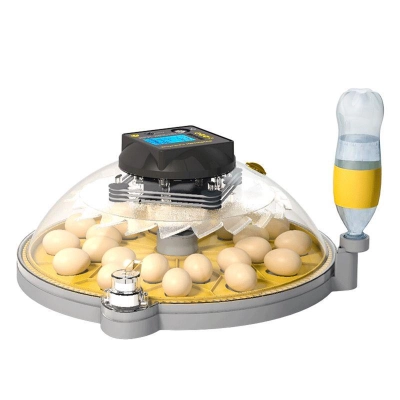
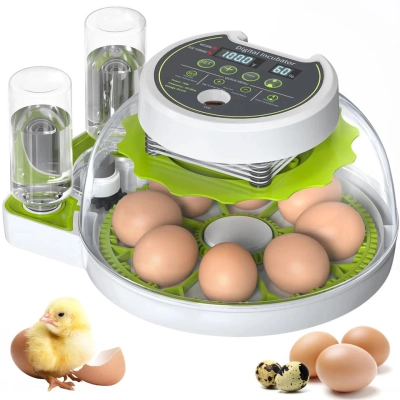
- Best fit for home and backyard hatching: a compact duck egg incubator that holds around 9–12 eggs, has simple digital controls, automatic turning, and a clear lid. This type fits on a shelf or washer, makes a soft fan sound, and lets you watch without lifting the cover every hour.
- Best fit for classroom projects: a low-noise incubator with a wide viewing window, easy external water refill, and automatic turning. This type lets a teacher run the hatch around the school week while students can see the eggs and ducklings without handling the machine.
- Best fit for small farms and homesteads: a larger-capacity incubator with steady airflow, stable temperature control, and trays or racks that are easy to load and scrub. Many small farms use two units, so they can stagger batches or move eggs if one machine fails during a storm.
If you already see yourself in one of these scenes and want to look at real machines, you can see all duck egg incubators on EggBloom and compare sizes and features that match your situation.
What duck eggs need inside an incubator (so your machine can keep up)
Before you worry about brand names, it helps to know what duck eggs actually need inside any incubator. A good machine makes these needs easier to hold steady. It does not replace basic care, but it gives you more control than a heat lamp or an uneven broody nest.
Temperature and time for duck eggs in an incubator
Most duck eggs need about 28 days in an incubator. Some heavier breeds can run a little longer, but planning for about 28 days is sensible for home, classroom, and small farm hatching. During that time, the eggs need warm and even heat.
A common target for forced-air incubators is around 99.5°F (about 37.5°C). The exact number on the screen is less important than how steady it stays over the full month. A duck egg that sits in a warm corner and then a cool corner day after day is more likely to give you a weak or late duckling.
| Stage | Days | Typical temperature | Notes |
|---|---|---|---|
| Main incubation | Day 1–25 | Around 99.5°F (37.5°C) | Eggs turn several times per day and stay in steady, even warmth. |
| Hatching period | Day 26–28 | Around 99–99.5°F | Turning stops, lid stays closed, and ducklings pip and hatch in higher humidity. |
Some incubators will always have small hot or cool spots, especially near the corners. This is normal to a point. You can reduce the risk by not stuffing eggs edge to edge, by letting the incubator preheat and settle before you set eggs, and by keeping the machine away from strong drafts or a window that gets cold at night.
Humidity, ventilation and the extra mess from duck eggs
Duck eggs handle moisture in a different way from chicken eggs. They often do best with moderate humidity through the main part of incubation and then higher humidity during the last few days. Many home hatchers aim for a reasonable, stable humidity level until around day 25 and then raise it so the inner membranes stay soft while ducklings hatch.
Good airflow also matters. The incubator needs to bring in fresh air and let out extra moisture and carbon dioxide without big swings in temperature. This is why a small fan and planned vent holes are so important in a duck egg incubator. A fan that blows hard in one spot and leaves other areas still can cause uneven development, even if the average temperature looks fine on the display.
Ducks also tend to lay eggs that are more dirty and oily. Mud, straw, and oil on shells, plus higher humidity, mean the inside of the incubator can get sticky and smelly if you leave it that way. A good duck egg incubator should have smooth surfaces and trays that are easy to pull out and wash in a sink. This is important for home users who share space with the incubator, and it is critical in a classroom where smell and hygiene matter to parents and school staff.
If you want a full step-by-step walk-through of the full 28 days, you can see our full duck egg incubation guide for beginners. That guide goes deeper into day-by-day checks, simple candling steps, and what to try when things do not look right.
Even with the right temperature and humidity, you will not see a 100% hatch rate every time. Egg age, parent flock health, rough handling during transport, and storage before incubation all have a big impact. A solid incubator helps you give the eggs a fair chance and makes problems easier to see, but it cannot fix issues that already came with the eggs.
Best duck egg incubators for home and backyard use
Backyard duck keepers often have simple goals and limited space. You may have a small flock, a job outside the home, and one quiet corner that is safe from children and pets. In this scene, ease of use, noise level, and cleanup are just as important as capacity and features.
Compact beginner-friendly duck egg incubators for home
A small, beginner-friendly duck egg incubator is often the best match for home use. A unit that holds around 9–12 duck eggs is big enough for a fun hatch and a small increase in your flock, but not so large that it becomes a major project. A clear lid lets you and your family see what is going on without opening the machine every time someone feels curious.
Look for a model with simple buttons and a clear display. You do not need complex programs or a long list of modes. You need a steady temperature reading, a basic way to track humidity, and automatic turning so you do not have to flip eggs by hand many times a day. When controls stay simple, it is easier to tell the difference between a real problem and your own confusion with the menu.
Think about the exact spot where the incubator will sit. A compact footprint fits better on a shelf, a washing machine top, or a small table that is away from doors and windows. A lighter unit is easier to move when you wipe the area or when you notice a draft at night and want to slide the incubator a little.
Quiet, low-maintenance picks for busy backyard duck keepers
Many backyard duck keepers are busy. They cannot stand next to the incubator and watch numbers all day. For them, a soft fan sound, a stable thermostat, and low daily fuss are worth more than an extra display mode.
If you fall into this group, pay attention to comments about fan noise and alarms. A gentle hum is usually fine. A high-pitched whine or frequent beeping will quickly annoy everyone in a small house. Try to choose an incubator that lets you add water from outside through a small port or tube. This simple feature lets you top up humidity without lifting the lid and dumping warm air into the room.
A design with smooth interior walls and removable trays will save you time over many hatches. Duck eggs can leak, crack, or even explode if one goes bad. When that happens, you will be glad if you can pull trays out and rinse them under a tap. Deep grooves and sharp corners make this job harder and increase the chance that smell and residue stay in the machine for the next batch.
When a chicken egg incubator is enough for duck eggs
Many people already own a chicken egg incubator and wonder if they must buy a second machine for ducks. In many home setups, a good chicken egg incubator can handle duck eggs if you treat humidity and space with extra care.
If the incubator has reliable digital temperature control, a fan for even airflow, and enough height and room for the larger duck eggs, you can often use it for both chicken and duck eggs. You may need to fill the water channels more often or add an extra tray of water during the last few days, but you do not always need a separate duck-only unit.
For mixed backyard flocks, a combined unit can be very handy. An automatic chicken and duck egg incubator for mixed backyard flocks lets you hatch both species in the same type of machine. You still adjust timing and humidity for duck eggs, but you learn one layout and one set of controls. This keeps things simpler when you are busy and saves space when your home does not allow for two machines.
Best duck egg incubators for classroom projects
Classroom hatching projects can be a strong memory for students. They can also turn into a headache if the setup ignores the school week, cleaning rules, or safety. A good classroom duck egg incubator has to work for the eggs and also for the teacher’s schedule and the school’s policies.
What really matters in a classroom duck egg incubator
Teachers usually need three things from a duck egg incubator. They need clear visibility so students can see the eggs and hatch without crowding the table. They need safe, stable operation so the machine can run from morning to afternoon without constant adjustment. And they need a simple plan for weekends and short breaks so they do not spend their days off worrying about water levels.
A classroom-friendly incubator should have a wide viewing window or a mostly clear lid. This lets the whole class see the eggs during a short lesson from their seats. Automatic turning is also very helpful, because it reduces the number of times the teacher must open the lid and reach over the eggs while students watch.
External water filling is another key feature. When the teacher can add water from outside, they can keep humidity in range with a small pitcher instead of lifting the lid. This is especially useful on Friday afternoons when they may want to top up water before the building closes. A low-noise fan and simple controls respect the classroom environment and keep the incubator from becoming a constant distraction.
Recommended classroom-ready duck egg incubators
In a classroom, the “best” duck egg incubator is not the one with the most settings. It is the one that fits on a safe surface, holds a manageable number of eggs, and can run for a full school day without drama. A good classroom unit will hold a modest number of eggs, often 8–12, and will be light enough to move if the custodian needs to clean the room.
Teachers can plan the hatch around the school calendar. Many choose to set eggs so that the main hatch days fall in the middle of the week, not over a long weekend. A simple calendar on the wall or board helps students follow the days. They can mark when the incubator will stop turning and when they should expect to see the first pips. If a holiday or test week lands near the due date, the teacher can adjust the start date before any egg is set.
If you want more step-by-step ideas on how to turn the incubator into a safe and engaging science project, you can see our duck egg incubator guide for kids and safe classroom science projects. That guide focuses on student activities, safety checks, and how to talk with students when some eggs do not hatch.
Best duck egg incubators for small farms and homesteads
Small farms and homesteads usually think in batches, not single hatches. They care about how many ducklings they can raise each season, how much time they spend tending machines, and how often they have to replace equipment. For them, capacity, build quality, and simple backup plans matter more than fancy screens.
Capacity and batch planning for small farm duck hatching
When you plan hatches on a small farm, it helps to think in rough yearly numbers and write them down. How many ducklings do you want per year? How many separate hatches make sense for your workload and brooder space? How many eggs can you collect in good condition in one to two weeks?
For example, if you hope for around 60 ducklings per year and you plan three hatches, you might aim for about 25 eggs per batch, because not every egg will hatch even under good care. In that case, a small 12-egg machine will feel cramped and force you to leave eggs out. A mid-size unit that can hold 30 or more duck eggs will give you more room to spread eggs and keep air moving.
Many homesteads like to run two medium incubators instead of one very large unit. This setup gives more flexibility. You can stagger hatches in two machines, keep one unit ready as a “hatcher” for the last three days, or move eggs to the second incubator if one fails. It also spreads risk, so one fault or power issue does not ruin every egg you set that month.
Best duck egg incubators for small farms and homesteads
A strong small-farm duck egg incubator has a few clear traits that you can check without marketing language. It holds enough eggs to match your planned batch size. It has a fan and a control system that keep temperature even across the whole tray, not just in the middle. It has trays or racks that let you load many eggs without stacking them or blocking airflow.
On a farm, easy cleaning and solid build quality are part of daily work, not extra luxury. They save you hours over a season and help you avoid bad smells near your brooder area. Look for an incubator with a sturdy shell, simple hinges, and trays that you can wash without fighting awkward corners. A lid that seals well but still allows planned ventilation will also help you keep results steady from batch to batch, even when the weather outside swings between cold nights and warm days.
When it makes sense to move up to a bigger system
There is a point where a tiny machine stops making sense for a farm. If you are often leaving eggs in the fridge or on the counter because your incubator is full, or if you find yourself running back-to-back hatches all spring and still falling behind your goals, it may be time to move up a size.
Before you buy, you can do a simple check. Estimate how many ducklings you really want each year. Then divide that number by a realistic hatch rate, such as 70–80% under good care. This will give you the number of eggs you should plan for in each batch. Then choose an incubator size that can handle that number without packing eggs tight against every wall.
When you move up to a bigger system, think about power, room temperature, and support. A thicker-walled machine and a stable room help you hold heat during short power dips. A clear idea of where you will put a second incubator gives you a backup plan before anything breaks. It is better to think about these details on a calm day than in the dark during a thunderstorm.
How to choose the right duck egg incubator for your budget and goals
At this point you know the basics. Duck eggs need about 28 days of stable warmth, suitable humidity, and fresh air. Home users, teachers, and small farms all face different limits and trade-offs. Now the key question is simple: what do you want from hatching, and how much money and time can you put into that plan?
Match your hatch goals to incubator capacity
First, be honest about your goals. If you only want to try hatching once with your kids and do not plan to repeat it often, you do not need a large incubator. A modest unit that holds under a dozen eggs is enough to share the experience. If you plan to hatch every year and perhaps sell extra ducklings, it makes sense to invest in a more robust machine that will run many batches.
For classroom use, capacity planning is also about student care. A class does not need 30 ducklings to learn from a hatch. In many schools, 8–12 eggs are already a lot to manage once they turn into live birds that need heat, feed, and a place to go after they leave the classroom. A smaller, well-planned hatch is better than a large one that overwhelms the teacher and the school’s space.
Small farms should think about flock size and housing. More ducklings mean more pens, more feed, and more time. It is often smarter to plan a few strong hatches and raise healthy ducklings than to chase maximum egg count in every batch and stretch your brooder space too far.
Budget tiers and what you really get at each level
Very low-cost mini incubators can be tempting when you scroll online. They may be fine for one casual experiment, but they often cut corners on insulation, sensors, and fans. You may spend more time trying to steady temperature and humidity than actually watching ducklings grow.
Mid-range incubators usually add better control boards, more stable fans, and practical details like external water filling and removable trays. For most home users and many teachers, this is the sweet spot. You pay more than the bottom shelf, but you gain stability and easier routines. Over several hatches, this can save money because you waste fewer eggs and feel less pressure to replace the machine.
Higher-end incubators for small farms focus on build quality and consistency over many seasons. They aim to keep each batch as similar as possible so you can plan around them. Even at this level, no machine can give a perfect hatch every time. There are always variables you cannot fully control. What you pay for is lower risk and less daily fuss, not a promise that every egg will become a duckling.
When you are ready to look at actual units and compare prices, you can compare duck egg incubators and prices on EggBloom and filter by capacity and features that match your goals and your space.
Duck egg incubator FAQ
Can I use a chicken egg incubator for duck eggs?
Yes, many people use a chicken egg incubator for duck eggs. The key is to check that the incubator has a fan for even heat, a stable thermostat, and enough room for the larger eggs to sit without touching the lid. You also need to pay closer attention to humidity. Duck eggs often need more moisture than chicken eggs, especially during the last few days before hatch.
How long do duck eggs take to hatch in an incubator?
Most duck eggs take about 28 days to hatch in an incubator. You may see the first external pips late on day 26 or day 27. Do not panic if a few eggs run a little early or late. Egg age, storage time before incubation, and small temperature differences can all shift the timeline by a day or two, even when you do your best.
Do duck eggs need higher humidity than chicken eggs?
Ducks usually do better with slightly higher humidity than chickens. Many hatchers use a moderate humidity for the first 25 days and then raise it during the hatch window to help ducklings slip free from the shell. If humidity stays too low, membranes can dry and cling around the duckling. If it stays too high for the whole 28 days, the air cell may not grow as it should and some ducklings may have trouble breathing at hatch.
Whatever incubator you choose, try to keep simple notes on each hatch. Write down your settings, room conditions, and results in a notebook or on your phone. Your first hatch may not be perfect, but your next one almost always improves when you know what actually happened instead of guessing from memory.

0 Comments