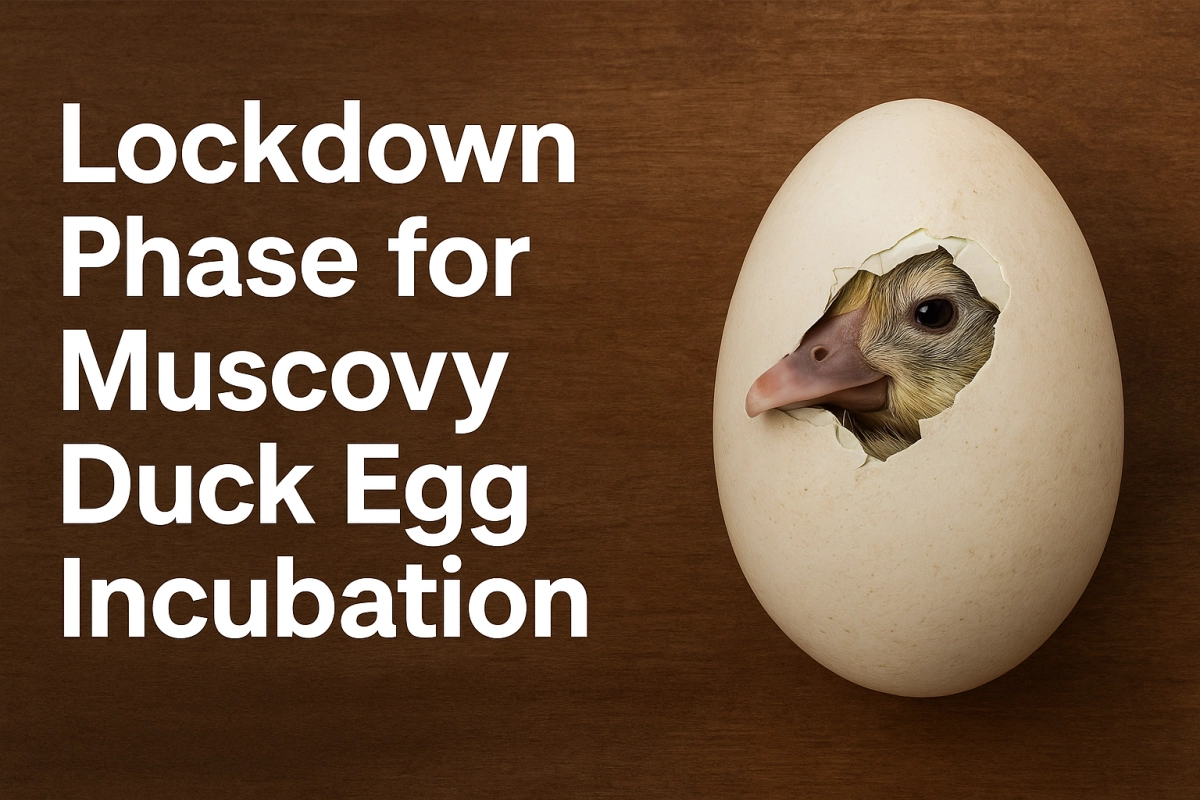
When you reach the final stage of hatching Muscovy duck eggs, excitement and anxiety rise together.
Those last few days—known as the lockdown phase—decide whether all your hard work will pay off.
Small changes in humidity or temperature can make or break the hatch.
This article walks you through what the lockdown phase is, when to start it, how to manage humidity and temperature, and how to prepare your incubator for success.
👉 For the full incubation process, see our Muscovy Duck Egg Incubation Guide
🐣 What Is the Lockdown Phase?
The lockdown phase is the final three days before hatching — typically Days 32–35 for Muscovy ducks.
At this stage, the embryos finish developing and begin positioning themselves to break through the shell.
Their beaks pierce the inner membrane to breathe air from the air cell, which means stability is vital.
Once lockdown begins:
-
Stop turning the eggs.
-
Keep the incubator closed.
Even a brief opening can drop humidity and cause the inner membrane to dry, trapping the chick.
Think of lockdown as the quiet zone — the calm before hatching begins.
🕒 When to Start Lockdown (Timing & Signs)
Start lockdown about three days before the expected hatch — around Day 32 for Muscovy eggs.
Watch for clear signs:
-
The air cell expands to about one-third of the egg.
-
You hear faint tapping or chirping from inside.
-
The embryo stops shifting position.
Once you spot these, stop turning and raise the humidity immediately.
Want a precise daily breakdown?
Check our Day-by-Day Incubation Chart
🌡️ Lockdown Settings: Temperature, Humidity & Turning
Lockdown is all about stability — keeping conditions constant while the ducklings prepare to hatch.
Recommended settings:
| Parameter | Ideal Range |
|---|---|
| Temperature | 36.8 – 37.2 °C (98.2 – 99 °F) |
| Humidity | 70 – 75 % |
| Turning | Stop completely |
Humidity is the single most important factor. It softens the inner membrane and prevents the chick from drying out.
Add shallow trays of warm water or a damp sponge to maintain moisture.
Keeping these conditions steady by hand can be tricky.
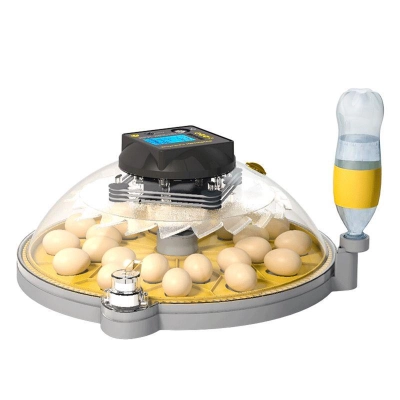
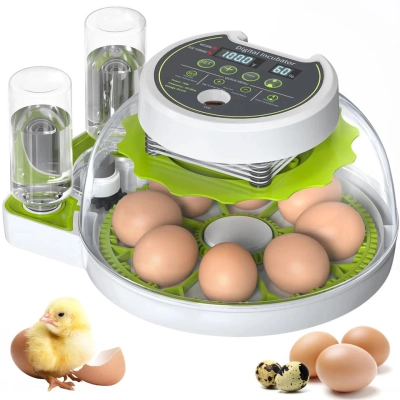
For consistent results, use an auto-turn dual-motor incubator that automatically balances airflow and humidity.
👉 Recommended model:
Chicken Duck Egg Incubator Auto Turn Dual Motor
🧰 Preparing the Incubator for Hatching
Before lockdown begins, treat your incubator like a delivery room — clean, stable, and ready.
-
Clean and disinfect the interior (avoid strong chemicals).
-
Add water to trays for steady humidity.
-
Open ventilation holes to improve airflow.
-
Check temperature sensors for accuracy.
-
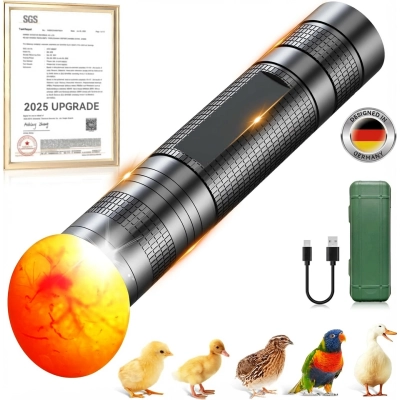
Optionally, do one final gentle candling to confirm development.
If you’re using a manual model and constantly adjusting settings, consider upgrading.
🔍 Explore all Duck Egg Incubators suitable for Muscovy eggs and long incubation cycles.
⚠️ Common Lockdown Mistakes to Avoid
Even experienced breeders make errors in the last few days. Avoid these pitfalls:
-
Opening the incubator lid — every opening drops humidity fast.
-
Low humidity — causes “shrink-wrapping,” trapping chicks inside.
-
High humidity — makes shells sticky and hard to break.
-
Overheating — leads to premature pipping or deformities.
-
Forgetting to stop turning — misoriented chicks fail to hatch.
A reliable incubator that regulates humidity and temperature automatically eliminates most of these risks.
🛒 See the Auto-Turn Dual Motor Incubator— its dual-fan design keeps airflow and temperature balanced throughout lockdown.
🐥 Signs of Successful Hatching
When conditions are right, you’ll start to notice life inside the shell:
-
Gentle rocking or tapping.
-
A tiny pip hole in the shell.
-
Soft peeping sounds as the chick breathes air.
From the first pip to full hatching may take 12–24 hours.
Be patient — assisting too early can harm the chick or cause unabsorbed yolks.
Keep humidity steady until every duckling is out and dry.



0 Comments