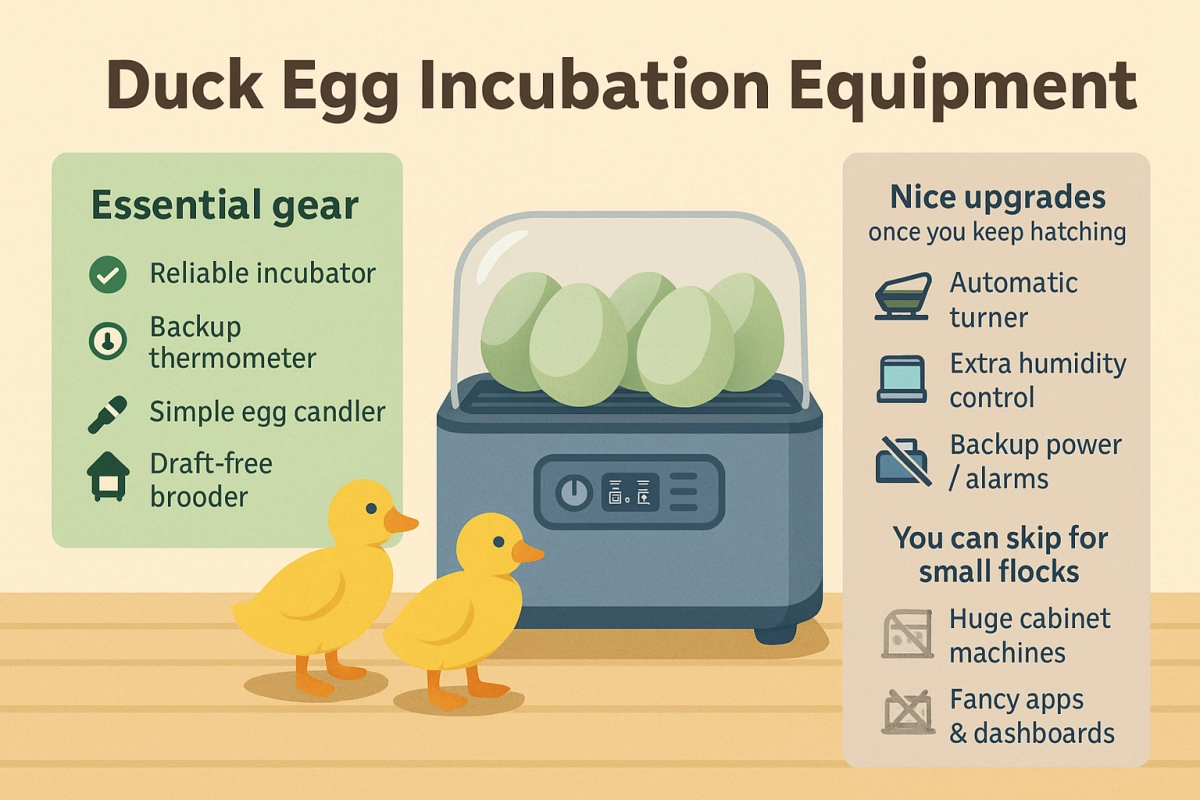
Duck egg incubation looks simple when you read a checklist. Set the temperature, add water, turn the eggs, wait for 28 days. In real life, you are balancing a warm box in a busy home or small farm, with limited time and a limited budget. You do not want to buy a pile of gear that looks impressive but does nothing to save your hatch.
This guide walks you through the equipment that actually matters for duck egg incubation. You will see what is truly essential, what is worth adding once you know you will keep hatching, and what you can skip for now. The goal is simple: a steady, realistic setup that gives your ducklings a fair start, without turning your first hatch into an expensive science project.
Key Takeaways
- Duck eggs need stable warmth, enough humidity, gentle airflow, and regular turning for about 28 days for most domestic ducks, and close to 35 days for Muscovy breeds. A reliable incubator and a way to double-check the settings are non-negotiable.
- You do not need a “duck-only” incubator. Many good chicken egg models work for duck egg incubation if they have space for larger eggs and enough control over humidity and ventilation. The weak point is usually humidity control and cleaning, not the label on the box.
- A separate thermometer and hygrometer, a simple egg candler, and a safe brooder are essential tools. They are cheap compared to the cost of losing a whole batch of eggs.
- Automatic turning, clearer viewing windows, digital controls, and extra trays are upgrades that make life easier. They help busy backyard keepers and homesteaders avoid missed turns or rough handling, but they do not replace the basics.
- High-tech features, large commercial machines, and many “pro” accessories are usually overkill for small flocks. They are designed around high volume, staff time, and industrial workflows, not a family kitchen or a small shed.
- No setup can promise a 100% hatch rate. With the right equipment and settings, many home duck keepers see hatch rates in the 60–80% range once they gain some experience. Your gear should give the embryos a stable environment; the rest comes from egg quality and your daily habits.
What Duck Egg Incubation Really Needs
Duck Eggs vs. Chicken Eggs
Duck eggs look like bigger chicken eggs, but they behave differently in the incubator. Most domestic ducks hatch in about 28 days, while Muscovy ducks take closer to 35 days. The shells are thicker, the eggs hold more moisture, and many duck eggs go into the incubator with dirt or stains still on the shell. That extra weight and grime change how heat and water move through the egg during incubation.:contentReference[oaicite:0]{index=0}
For forced-air incubators, a target temperature around 99.5°F (37.5°C) works well for duck egg incubation. In still-air machines, the air sits in layers, so you measure at the top of the eggs and usually run a bit warmer, around 101–102°F (38.3–38.9°C). Humidity for duck eggs stays in a moderate range early on, then rises in the last three days to help ducklings break through the shell without drying out or drowning.:contentReference[oaicite:1]{index=1}
Because duck eggs are heavier and need more time, small mistakes in temperature and humidity can drag on for weeks before you see the impact. That is why your equipment must hold a steady line. When the incubator swings up and down or dries out too often, embryos get stressed, lose or hold too much water, and fail late in the game.
Key Conditions for Hatching Duck Eggs
For our purposes, duck egg incubation has four basic needs. Every piece of equipment you buy is there to serve one of them: stable temperature, suitable humidity, gentle airflow, and regular turning.
- Stable temperature: Keep the incubator around 99.5°F (37.5°C) in forced-air models, and a bit higher at egg height in still-air units. Short dips happen when you open the lid, but repeated swings or long spikes are what kill hatches.
- Controlled humidity: Aim for roughly 55–60% relative humidity for most of the incubation period, then raise it to about 65–80% during the last three days. The exact number matters less than consistency and proper moisture loss over time.:contentReference[oaicite:2]{index=2}
- Gentle airflow: Ventilation lets fresh air in and stale air out without creating drafts over the eggs. Your incubator should not feel like a wind tunnel, but it also cannot sit sealed tight.
- Regular turning: Duck eggs need several turns per day, usually 4–6 times, until lockdown. Turning keeps the embryo from sticking to the shell membranes and supports proper development of blood vessels and air cells.:contentReference[oaicite:3]{index=3}
If your equipment can provide these four conditions and you use it with some discipline, your setup is good enough to start. If you want a step-by-step process that walks from egg selection through hatch day, you can pair this gear guide with our complete duck egg hatching guide.
Essential Equipment for Duck Egg Incubation
Picking a Good Incubator
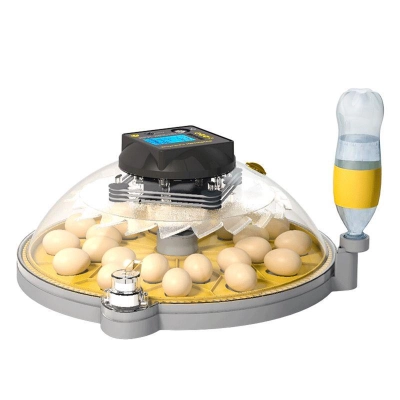
The incubator is the heart of your setup. For duck eggs, you do not need an industrial machine, but you do need a unit that can hold a steady temperature and give you real control over humidity. That is where many cheap foam boxes and toy-style incubators fall short.
A practical duck egg incubator for small flocks should do a few things well:
- Hold a stable temperature close to 99.5°F in normal room conditions, without constant manual tweaking.
- Offer enough space for larger duck eggs so they do not hit the lid or press hard against each other.
- Include water channels or trays that can keep humidity in the target range with simple top-ups.
- Allow easy cleaning between hatches so dried shell, yolk, and down do not build up and feed bacteria.
If you want to compare designs and see which models are built with duck egg incubation in mind, you can start with our duck egg incubator collection. The idea is not to chase the fanciest machine, but to choose something honest and stable that matches how many eggs you plan to hatch in a year.
Thermometer and Hygrometer Basics
Almost every incubator ships with a built-in display, but many home units read a little high or low. That small error becomes a big problem when you run for 28–35 days. Experienced hatchers almost always back up the built-in readings with at least one separate thermometer and hygrometer.
Your backup thermometer does not need to be expensive. What matters is that you place it at egg height, check it at the same times each day, and compare it to the incubator’s display. If the internal reading is off by a degree or more, you learn to adjust your settings around that gap instead of trusting the factory calibration blindly.
The same goes for humidity. A simple digital hygrometer inside the incubator lets you see if your water channels and ventilation settings are doing what you think they are doing. For duck egg incubation, that feedback is more important than chasing a perfect number on day one. Over a full hatch, you want humidity that stays in range and allows the eggs to lose the right amount of water, not a number that jumps every time someone opens a door.
| What you see | What it likely means | What to do |
|---|---|---|
| Incubator reads 99.5°F, backup shows ~98.5°F | Built-in sensor is reading a bit high | Raise the set point slightly and retest until both readings line up in a safe range |
| Humidity stuck under 45% with water channels full | Room air is very dry or vents are too open | Close vents a little or add extra surface area for water without flooding the base |
| Humidity often over 70% early in the hatch | Too much water or poor airflow | Reduce the water level, open vents a bit, and watch air-cell size over time |
If you want a deeper walkthrough on how to balance temperature and humidity across the whole hatch, our incubator temperature and humidity guide pairs well with the tools in this section.
Egg Candler and Simple Brooder
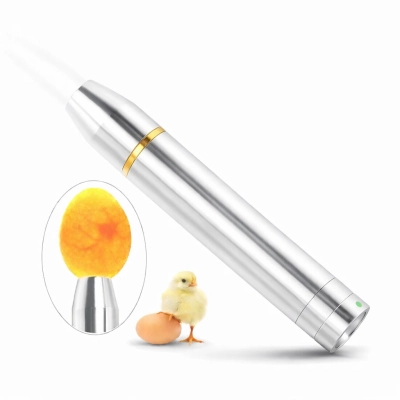
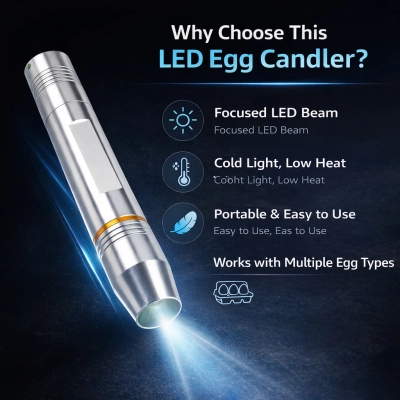
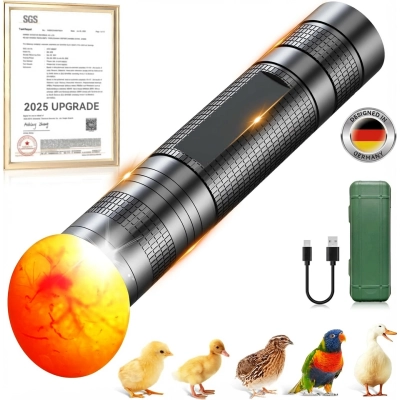
A candler is any safe, bright light that lets you look into the egg without overheating it. Fancy candlers are nice, but a strong LED flashlight and a bit of cardboard or foam to block light around the shell will do the job for many backyard keepers.
Candling duck eggs at a few key points in the hatch helps you spot clears, early quitters, and late-stage problems. You save space and reduce contamination risk by pulling out eggs that are clearly not developing. You also see whether air cells are growing at a healthy pace, which ties back to how honest your humidity settings are.
Once ducklings hatch, they cannot stay in the incubator for long. You need a simple brooder: a draft-free box, a safe heat source, non-slip bedding, and access to fresh water and starter feed. This does not have to be expensive or elaborate. What matters most is that ducklings stay warm without crowding, do not slip on slick surfaces, and cannot drown in deep water dishes.
Optional Gear for Hatching Duck Eggs
Automatic Egg Turners
Turning eggs by hand works when you are hatching a few eggs and you are home most of the day. Once you are working full-time, taking care of kids, or running a small farm, turning duck eggs 4–6 times a day by hand becomes the step you are most likely to forget.
Automatic turners do one simple thing: they move the eggs on a schedule so you do not have to open the incubator every few hours. That keeps your routine honest and reduces the number of times you drop temperature and humidity. For many people, this upgrade pays off in peace of mind rather than a magic boost in hatch rate.
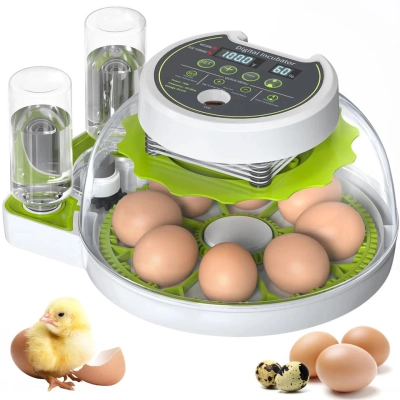
If you already know that you will be running more than one batch of duck eggs, an automatic unit such as our automatic chicken and duck egg incubator can move from “nice extra” to “realistic minimum” very quickly. It is not about being fancy; it is about not missing turns on day 17 because a sick kid kept you up all night.
Extra Humidity Trays and Controls
Some incubators come with add-on water trays, wicks, or modular reservoirs that help you fine-tune humidity. For duck egg incubation in dry climates, those extras can make life easier, especially in the last week of the hatch when you want a stronger humidity bump.
If your home stays fairly stable and your basic water channels keep humidity in range most of the time, you may not need extra hardware. Instead, you can learn to adjust humidity by changing water surface area and vent positions. Once you push into more frequent hatches or tricky environments, those extra controls are worth a second look.
Backup Power and Convenience Features
Short power cuts happen. In most mild cases, duck eggs can handle a brief cool-down and still hatch well. Long, repeated outages are a different story. For homesteads in areas with unstable power, a small backup supply that keeps the incubator running for a few hours can protect a lot of time and effort.
Convenience features like clearer digital displays, alarms for high or low temperature, or simple data logs can also help you spot problems before they ruin a batch. They are not truly essential for small flocks, but they do make your habit of checking the incubator easier to keep.
What to Skip When You Hatch Duck Eggs
Overhyped High-Tech Gadgets
The market is full of smart incubators, phone apps, and streaming cameras. These tools are fun for people who already have the basics locked in, but they are not what makes a first duck hatch succeed. Many small keepers end up watching graphs on their phones while the eggs sit in a machine that is hard to clean or take apart.
For a first or second hatch, you can safely skip:
- Wi-Fi app control that lets you change settings from your sofa but does not fix weak heating elements or bad sensors.
- Very expensive “pro-level” candlers when a safe, bright handheld light already lets you see veins and air cells clearly.
- Data-heavy dashboards that show every micro-change but tempt you to over-adjust instead of holding a steady baseline.
When you run several hatches a year and know your own bad habits, some of these tools might start to make sense. At the start, they mostly make the learning curve steeper and your shopping cart more expensive.
Large-Scale Farm Equipment
Commercial hatcheries use incubators the size of closets or small rooms. They rely on staff, strict routines, and careful cleaning plans. None of that fits a backyard with a handful of ducks and a single power outlet in the shed.
If a unit is advertised mainly on how many hundreds of eggs it can hold at once, or if it expects a plumbed-in water source and a dedicated room, it is almost never the right choice for a small flock. You will spend more time and money on a machine you cannot run at full capacity or clean easily between batches.
| Gear type | Built for | Why small flocks can skip it |
|---|---|---|
| Walk-in cabinet incubators | Large farms hatching hundreds of eggs per week | Too big, too hard to clean, and too expensive for a dozen duck eggs |
| Fully automated climate rooms | Commercial hatcheries with staff and dedicated spaces | Not practical in homes, sheds, or classrooms with mixed use |
| Industrial humidity systems | Continuous high-volume hatching lines | A basic incubator with good trays and vents already covers backyard needs |
Most experienced small-scale duck keepers started with a modest, honest machine and a few simple tools. They upgraded later, when they knew they would keep hatching every season and they could see exactly which limits were holding them back.
Using Chicken Incubators for Duck Egg Incubation
When a Chicken Incubator Works
Many readers already own a chicken egg incubator and want to know if it can pull double duty for duck egg incubation. In a lot of cases, the answer is yes, as long as the physical space and humidity range are suitable.
A chicken incubator usually works for duck eggs if:
- The egg tray has enough depth and spacing so duck eggs do not ride against the lid or crush each other.
- You can reach and hold about 55–60% humidity for most of the hatch and raise it higher at the end without constant struggle.
- The unit is easy to wipe down, disinfect, and dry between hatches so you do not trap moisture and bacteria around the fan or wiring.
When these boxes are ticked, you can use your chicken incubator for duck eggs by adjusting settings and paying closer attention to humidity and cleanliness. It is a practical way to learn without buying a second machine on day one.
Signs You Need to Upgrade
Some incubators are simply too cramped or limited for duck egg incubation. It is better to admit that up front than to push several batches of eggs through a machine that keeps fighting you.
You may want to upgrade to a duck-friendly model if:
- You cannot fit a full clutch of duck eggs without stacking or forcing them into trays made for small chicken eggs.
- Humidity either sits very low even with full water channels or spikes into the 70–80% range with only a small change in water level.
- The incubator is made of material that absorbs grime, is hard to scrub, or traps fluff and yolk in corners you cannot reach.
When your current machine hits these limits and you know you want to keep hatching ducks, it is time to look for a dedicated unit that fits duck eggs comfortably. Our duck egg incubator home guide explains how settings and hardware choices work together in a realistic home setup.
Simple Setups for Different Duck Keepers
Backyard Flock Starter Kit
If you keep a small backyard flock and want to hatch a dozen duck eggs once or twice a year, your setup can stay compact and simple. You do not need a full room of gear. You need one honest machine and a few tools you will actually use.
- A small forced-air incubator that holds 12–24 eggs with clear viewing windows and simple water channels.
- One backup digital thermometer and hygrometer at egg height.
- A basic LED flashlight for candling at key days.
- A plastic bin or wood box as a brooder, with a safe heat source and shallow water dishes.
Place the incubator in a quiet room away from windows, vents, and heavy traffic. If you are not sure where that should be in your home, our egg incubator placement guide shows how to test your rooms and avoid hot and cold spots.
Homestead Upgrade Options
On a small homestead where you plan to hatch multiple batches of duck eggs each year, your needs slowly shift. You will want equipment that can keep running, clean up well, and hold a bit more capacity without making your workday longer.
- A mid-size incubator that can handle a few dozen duck eggs with sturdy trays and a strong, quiet fan.
- Built-in automatic turning plus a reliable backup thermometer and hygrometer.
- Extra water trays or modular reservoirs if your climate is very dry or you notice humidity is hard to control toward lockdown.
- A brooder setup that can scale up for larger groups of ducklings without crowding.
At this stage, small upgrades like an alarm for low humidity, better viewing windows, or a unit that is easier to hose out between batches are often worth the cost. You are spreading the investment over many more ducklings, not just a single family hatch.
Classroom Project Essentials
In classrooms, the biggest constraints are time, attention, and safety. Students want to see every step; teachers need a setup that can survive curious hands, short class periods, and strict school rules.
A good classroom duck egg incubation setup usually looks like this:
- A compact incubator with a clear lid or large windows so students can watch without opening it.
- Simple, locked-in controls that students cannot change by accident during a lesson.
- A stable table away from doors, radiators, and open windows, with cables taped down so nobody trips.
- A brooder that keeps ducklings contained, dry, and warm until they go to their long-term home.
If you plan a class project around duck egg incubation, you may also want to read our classroom-focused duck egg incubator safety guide for kids so you can plan hygiene, supervision, and rehoming before the first egg ever goes into the machine.
FAQ
How often should you turn duck eggs during incubation?
For most duck breeds, turning eggs 4–6 times per day works well. The key is consistency. Small, frequent turns are better than big, rare movements. Stop turning two or three days before hatch so the ducklings can settle into position without being disturbed.:contentReference[oaicite:4]{index=4}
Can you use a chicken egg incubator for duck eggs?
Yes, many chicken egg incubators can handle duck egg incubation if they have enough room for larger eggs and enough control over humidity. You may need to adjust water levels and vent positions more often. If you constantly fight low or high humidity or you cannot clean the unit well between hatches, it is time to consider a model designed with duck eggs in mind.
What should you do if humidity drops too low?
First, stay calm. Short dips will not ruin a hatch by themselves. Check that the water channels or trays have enough water and that vents are not open more than they need to be. Add water in a way that increases surface area rather than flooding the base, then watch the hygrometer over the next hour. If you catch low humidity early and correct it, duck eggs can usually recover without trouble.


0 Comments